
Home moves
House removals in London, priced after we have seen the job
Most house removals quotes are a guess dressed up as a price. Somebody asks how many bedrooms, says a number, and the number moves on the day. We survey first — usually a ten-minute video call — and then put it in writing.
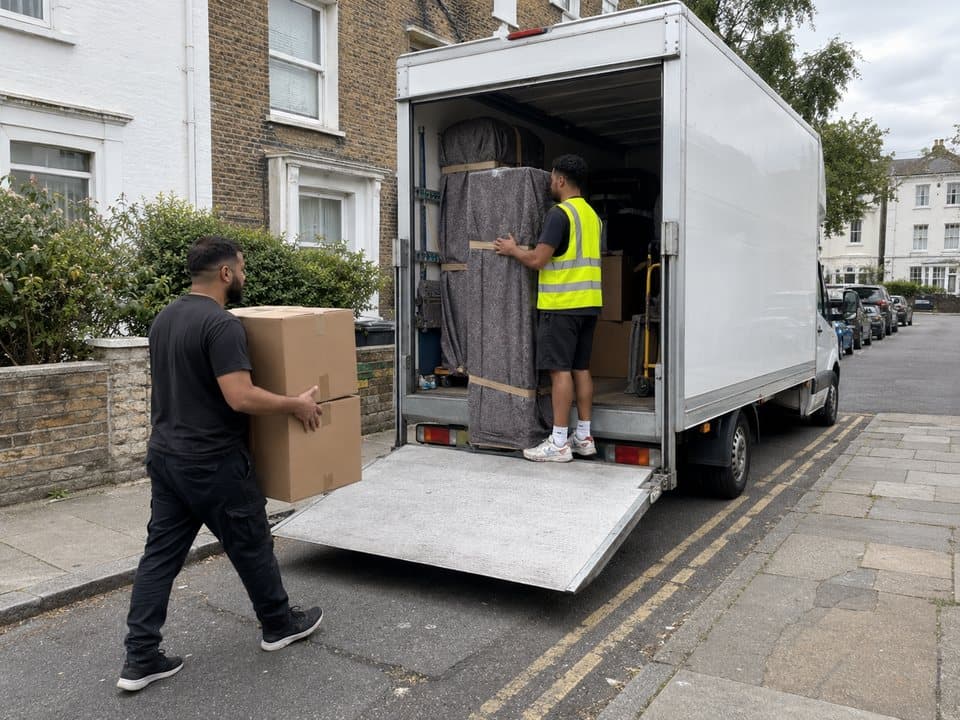
Quoted after
A survey, not a phone call
You get
An itemised price in writing
We cover
Every London postcode
What it costs
What decides the price of house removals in London
It is almost never the number of bedrooms. Two identical three-bed terraces can be hundreds of pounds apart, and the difference is nearly always access rather than volume. This is what we are looking at during the survey, in roughly the order it matters.
How far the van can park
Every metre of pavement is carried, twice, by hand. A van on the drive and a van ninety metres down a permit street are two different jobs with the same furniture in them.
The floor, and the lift
A second-floor flat with a working lift is usually quicker than a ground-floor maisonette with a half-landing turn. And plenty of lifts will not take a sofa.
The turns, not the stairs
Stairs are just time. What costs money is the corner at the bottom of them, the width of the front door, and whether a wardrobe has to come apart to leave the room.
How much is really going
Lofts, sheds, the cupboard under the stairs and the garage are the four places that turn a two-van job into a three-van job on the morning. A video call finds them.
The day of the week you move
Fridays and month-ends are when everybody moves, which is when crews and vans are scarcest and the roads are worst. A Tuesday in the middle of the month is the same job done in less time.
Whether you are packing
Packing is roughly a third of the labour on a full house move. Doing it yourself is the single biggest saving available to you, and we will say so rather than quietly quote for it.
So what would yours cost?
Ten minutes on a video call and you will have it in writing. No obligation, and no number invented over the phone.
Before the day
The parking is the part people forget
In most of London you cannot simply leave a Luton outside the house for the day. On a controlled parking zone the bay has to be suspended, or a removals dispensation obtained from the council, and boroughs want notice — often the best part of a working week.
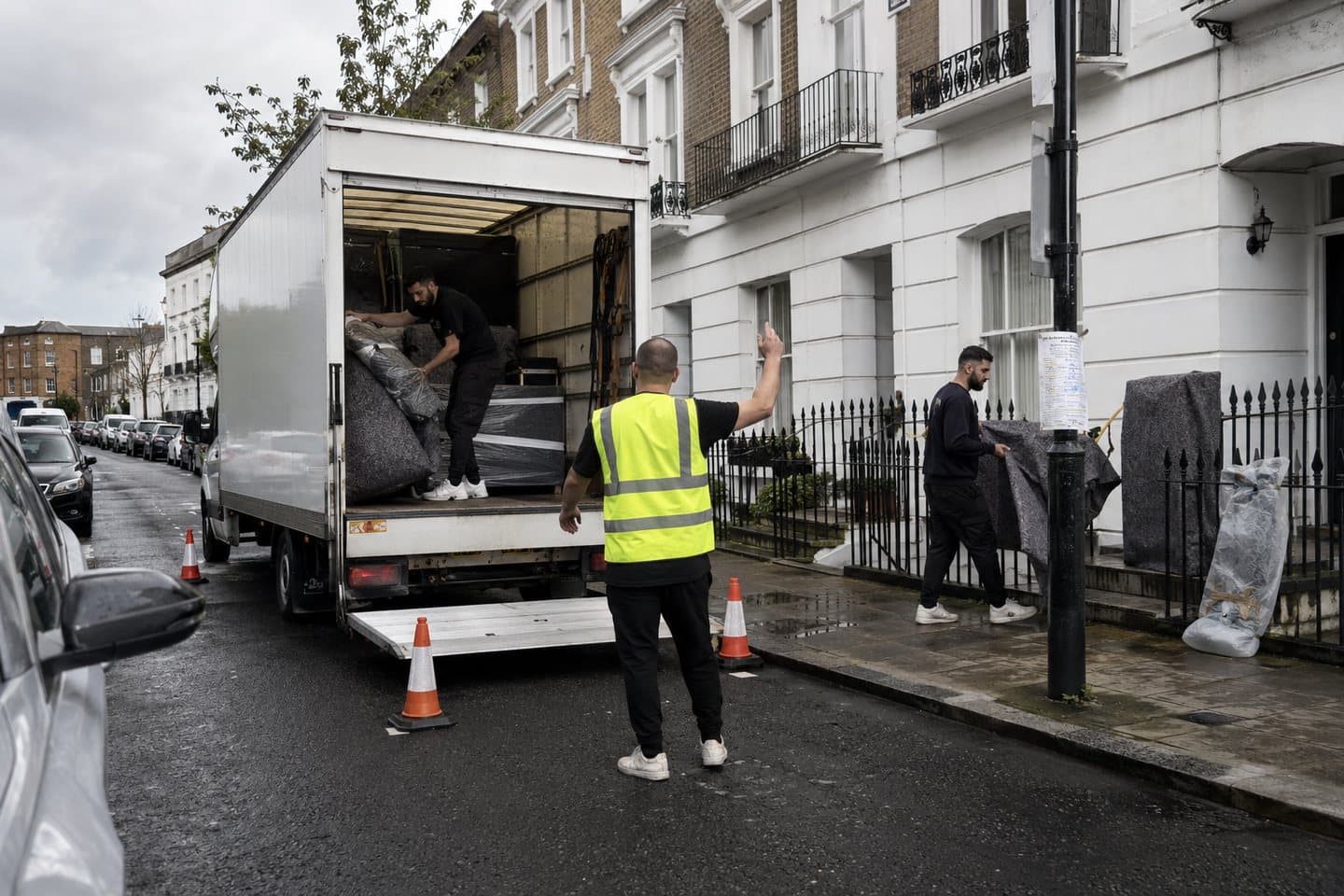
It is the most common reason a move starts badly. The van arrives, there is nowhere legal to put it, and the crew are carrying from wherever they could stop while a warden works along the street.
We raise it at the survey rather than on the day, and we will tell you which end needs it. Rules and fees differ by borough, so the specifics come from your council.
On the day
How the day itself runs
Three things that happen on every job, before and after the lifting.
- 01
The route gets walked
Doorways, the turn at the bottom of the stairs, where the van can sit, which way the sofa has to come out. Two minutes then saves an hour and a scraped wall later.
- 02
The load is built in sections
Furniture is blanket-wrapped and strapped as it goes in, not strapped once at the end. A load that shifts on the North Circular is a load that was strapped once, at the end.
- 03
Both places get a walk round
The old one for the cupboard somebody forgot, the new one so nothing ends up in the wrong room and has to be lifted twice.
The quote
What the price covers, and what it does not
Both lists go on the written quote, so there is nothing to discover afterwards.
Included
- A survey before the price, by video call or in person
- The quote in writing, itemised, with what is not included spelled out
- Loading and unloading, and furniture placed where you want it at the other end
- Furniture wrapped in blankets and protective covers
- Dismantling and reassembly of flat-pack and standard furniture
- Disconnecting and reconnecting a washing machine
- Wardrobe boxes to borrow, so hanging clothes travel on the rail
- The route walked before anything is lifted, and a final walk round at both ends
Not included
- Parking suspensions or council dispensations — we tell you what is needed, you apply
- Packing materials and packing labour, unless you add them to the quote
- Anything gas: a cooker or gas appliance has to be disconnected by a Gas Safe engineer
- Plumbing beyond a washing machine's own connections
From our Google profile
What people said about their move
Left on our Google profile. Every card links back to it, so you can read the rest — including any we would rather you did not.
Good experience with Metro City Moves. 4 bedroom house seemed bit difficult to move from London to Liverpool, but they planned well and successfully executed. Thank you.
Saqib AwanRead on Google, opens in a new tab
Before you book
Questions people actually ask
How far in advance should I book a house move?
Two to four weeks is comfortable. The pinch points are the last working day of the month and Fridays, which is when most completions land, so those go first. If you need a parking suspension the council's notice period usually sets the earliest sensible date rather than our diary.
Do I have to be there on the day?
Someone does, at both ends, or at least for the start and the finish. Somebody has to say what is going and what is staying, and somebody has to say which room things go in. If that cannot be you, tell us who it is at the survey.
Can you do the move over two days?
Yes, and for larger houses or a difficult completion it is often the calmer option — load one day, unload the next. It needs to be priced that way from the start though, because it changes both the crew and where the load sits overnight.
What happens if the price changes on the day?
It should not, because the survey is what stops that. If something turns up that was not in the survey — a loft nobody mentioned, or a bay that was never suspended — we tell you what it costs before we do it, not afterwards on the invoice.
How many movers will come?
Whatever the job needs, which is what the survey decides. Crew size is the main thing that moves a price, so it is settled in writing beforehand rather than adjusted on the morning when somebody realises two people are not enough.
Will you take my furniture apart?
Beds and flat-pack wardrobes usually have to come apart to leave the room, and that is part of the job. Anything beyond that, say at the survey so it is in the written price rather than a conversation on the day.
Related reading
The things that catch people out
Parking, vans and packing — the rules read from the source, dated when checked.
- Guide
A moving house checklist for London, built around the dates
A moving house checklist built around London's real deadlines — the parking notice your borough demands, the ULEZ check, and what to do in the last week.
Read it - Guide
How to pack electronics for moving
Back up first, photograph the cables, remove the batteries, wrap each device in anti-static bubble wrap and keep every screen upright. The full order.
Read it - Guide
Moving out of a London flat, and what the building decides for you
What decides how a London flat move goes — whether the lift can be booked, the turn on the stairwell, and where the van is allowed to stop while you carry.
Read it - Guide
Moving to Battersea: the two completely different moves it can be
Moving to Battersea is two jobs: a Nine Elms tower where the goods lift rules, or a Victorian terrace where Wandsworth charges £43.40 to hold the kerb.
Read it - Guide
Moving to Clapham: the flat share, the terrace, and the £156 you can avoid
Moving to Clapham usually means a converted Victorian terrace and a Lambeth bay suspension, where applying a few days late can add £156.31 to the same booking.
Read it - Guide
Moving to Stratford: the lift slot matters more than the van
Moving to Stratford is mostly a new-build move: the goods lift booking decides the day, and Newham publishes its suspension charges only via its portal.
Read it
Get it priced properly
A survey first, then the number in writing. Answered at any hour.