How to move house contents in stages: London guide

Moving house contents in stages is defined as a phased approach to packing and relocating your belongings by priority and room, rather than attempting everything at once. This method is the most effective strategy for London homeowners because it keeps your home functional for longer, reduces last-minute panic, and lowers the risk of damage to your possessions. Professional removals guidance, including the approach used by Metrocitymoves, consistently recommends a staged moving process built around three core phases: early decluttering, progressive room-by-room packing, and a reserved final stage for daily essentials. Done correctly, it turns one of life’s most stressful events into a manageable sequence of tasks.
How to move house contents in stages: the right order
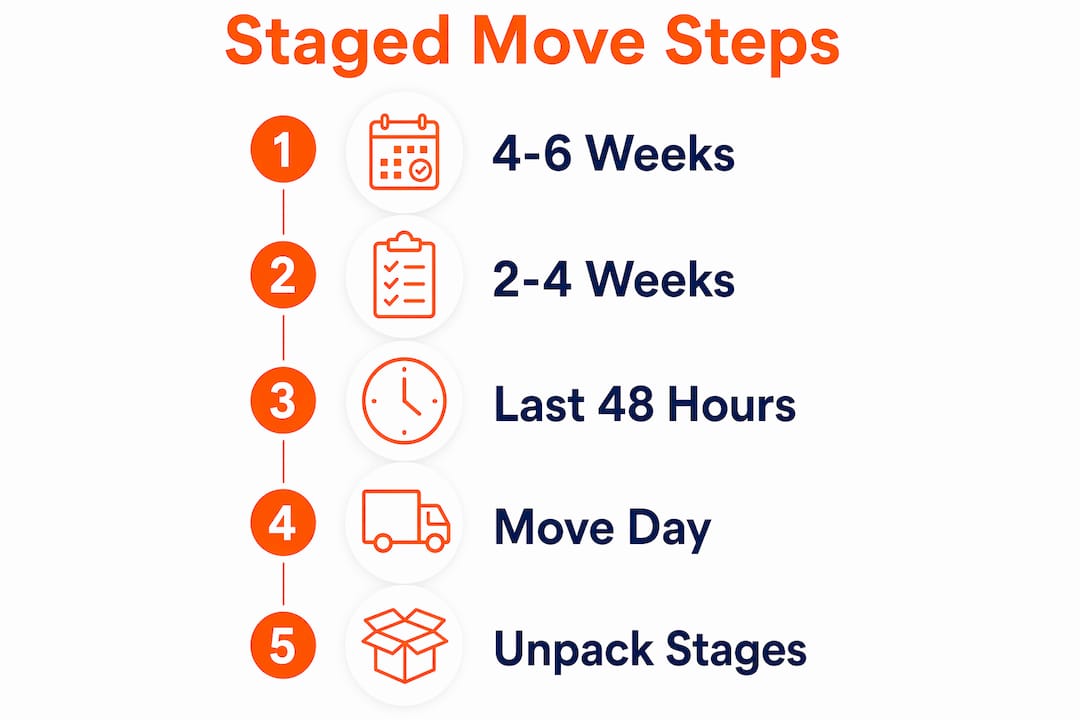
The most effective staged moving process starts with low-use rooms 4–6 weeks before your move date. Lofts, garages, outbuildings, and storage cupboards contain items you rarely need. Packing these first gives you immediate progress without disrupting daily life.
From 2–4 weeks out, move to non-essential living areas. Spare bedrooms, home offices, and decorative items in reception rooms are good targets. You can live without a guest room duvet or a bookshelf of novels for a few weeks without noticing.

The kitchen, bathrooms, and your daily wardrobe are the last areas to pack. Reserve these for the final 48 hours before move day. This sequencing is the core logic behind phased home moving: keep the busiest rooms functional for longer and pack them only when you genuinely have to.
One mistake many London homeowners make is packing too much too soon. Filling every room with boxes weeks before completion creates what professionals call “cardboard warehouse syndrome.” Your home becomes difficult to live in, and if the sale falls through, you face the misery of unpacking everything again. Only begin serious packing once your sale is legally secured.
Key packing priorities by phase:
- Weeks 5–6 before move: Loft, garage, garden shed, storage rooms, seasonal items
- Weeks 3–4 before move: Spare bedrooms, home office, books, decorative items, hobby equipment
- Week 1–2 before move: Non-essential kitchen items, out-of-season clothing, artwork, mirrors
- Final 48 hours: Kitchen essentials, bathroom items, daily clothing, bedding, children’s items
- Move morning only: Phone chargers, medication, kettle, mugs, and your “first night box”
Pro Tip: Label every box with its destination room at the new property, not where it came from. Writing “Main Bedroom” rather than “Spare Room” means the removal team places boxes correctly on arrival, saving you hours of shuffling.
How to plan materials and logistics for a staged move
Good logistics planning separates a smooth phased move from a chaotic one. The first practical step is estimating your packing materials accurately. Most homeowners underestimate their box needs by around 30%, which leads to expensive last-minute purchases from local shops at inflated prices. Order more than you think you need and return unused flat-packed boxes afterwards.
Use double-wall boxes for books, crockery, and anything heavy or fragile. Single-wall boxes collapse under weight and are a false economy. Bubble wrap and packing paper are non-negotiable for glassware and ceramics. Plates pack best when stood vertically, not stacked flat, which dramatically reduces breakage risk.
A simple spreadsheet tracking box numbers, contents, and destination rooms pays dividends on move day. You do not need specialist software. A shared Google Sheet works perfectly and means your partner or helpers can update it in real time.
Logistics planning checklist:
- Confirm your completion date before ordering materials or booking vehicles
- Book your removal company at least 3–4 weeks in advance for London moves
- Align packing phases with helpers’ availability, not just your own schedule
- Arrange storage access dates if you are using interim storage
- Photograph cable setups and appliance connections before dismantling
The table below compares the three main approaches to a staged move, so you can choose the level of professional support that fits your budget and timeline.
| Approach | Who does the packing | Typical cost range | Best suited to |
|---|---|---|---|
| Self-pack staged move | Homeowner entirely | Materials only | Flexible timelines, tight budgets |
| Part-professional staged move | Homeowner packs most; professionals handle fragiles | £100–£300 extra | Busy households with fragile items |
| Full professional staged move | Removal company packs everything | £250–£600 depending on volume | Large homes, time-poor homeowners |
What professional services should you consider for a staged move?
Professional packing services reduce two things that matter most during a move: time and damage risk. Professional packers work methodically, using protective padding and packing with transit safety in mind rather than storage convenience. That distinction matters because a box packed for a shelf looks very different from one packed to survive a van journey across London.
Partial professional packing is the option most London homeowners overlook. You pack the straightforward items yourself, and the professionals handle the kitchen and fragile items. Partial packing typically adds £100–£300 to your removal cost and saves one to two evenings of difficult, high-risk work. For most households, that is a straightforward trade.
Containerised storage is the other professional service worth serious consideration. When completion dates do not align, or when you want to declutter before viewings, storage bridges the gap without requiring multiple van trips. Metrocitymoves offers secure removal storage across London, which integrates directly with a staged move plan and avoids the double-handling that damages belongings.
Benefits of professional packing integration:
- Fragile kitchen items packed correctly the first time, with no re-packing required
- Consistent labelling and box orientation that speeds up unloading
- Goods in Transit cover applies to professionally packed items, reducing your financial risk
- Frees up your final days before move for cleaning, admin, and family
Pro Tip: Ask your removal company whether their Goods in Transit insurance covers self-packed boxes. Many policies only fully cover items packed by their own team. Knowing this in advance helps you decide which items to hand over to professionals.
How to manage move day and the final stage effectively
Move day is where a well-planned staged move either pays off or falls apart. The single most important rule is this: your “first night box” must travel in your car, not in the removal van. Van arrival times in London are unpredictable due to traffic. If your essentials are in the van, you may spend your first hours in the new home without a kettle, medication, or phone charger.
“Pack your first night box as if the removal van will not arrive until tomorrow morning. Include a kettle, mugs, tea, coffee, phone chargers, medication, a change of clothes, children’s comfort items, and bedding for every person in the household. Treat it as your overnight bag for the new home.”
The loading sequence of the van matters more than most homeowners realise. Load items strategically so that the last items loaded are the first needed at the new property. Bedroom boxes go in last if bedrooms are the priority on arrival. Fragile items travel with padding on all sides and are never placed under heavy boxes.
Move day sequence:
- Defrost the fridge and freezer the night before. A wet, dripping appliance on move morning causes delays and mess.
- Complete a final walkthrough of every room, cupboard, loft hatch, and outdoor space before the van leaves.
- Load the van with heavy furniture and large boxes first, then fill gaps with lighter boxes.
- Place fragile boxes last, clearly labelled “Fragile,” and position them where they cannot shift in transit.
- Keep your first night box, important documents, and valuables with you at all times.
- At the new home, direct the removal team to place boxes in the correct rooms immediately. Correcting this later wastes significant time.
Pro Tip: Take a short video walkthrough of every room in the old property after the van has loaded. This protects you against any deposit disputes and confirms nothing has been left behind.
Unpacking at the new home works best when you apply the same staged logic in reverse. Set up the kitchen and bedrooms first. Leave storage rooms and loft spaces for last. You will feel settled far sooner if the rooms you use daily are functional within 24 hours.
Key takeaways
Phasing your move by room priority is the single most effective way to reduce stress, protect your belongings, and keep your home liveable until the last possible moment.
| Point | Details |
|---|---|
| Start with low-use rooms | Pack lofts, garages, and storage areas 4–6 weeks out to make immediate progress without disruption. |
| Label boxes by destination | Write the new room name on every box so the removal team places items correctly on arrival. |
| Order more materials than you think | Most homeowners underestimate box needs by around 30%, leading to costly last-minute purchases. |
| Use professional packing for fragiles | Partial professional packing adds £100–£300 and saves hours of high-risk work on kitchen and glassware. |
| Keep your first night box with you | Essential items must travel in your car, not the van, to guarantee access regardless of arrival times. |
What I have learnt from watching London moves go wrong
The homeowners who struggle most with staged moves are not the ones who pack too little. They are the ones who pack too much, too early, without a plan. I have seen families in London living around towers of boxes for six weeks because they started packing before their sale was confirmed. When the chain collapsed, they unpacked everything. The stress was entirely avoidable.
The second most common mistake is underestimating how long the kitchen takes. People pack spare bedrooms in an afternoon and assume the kitchen will be similar. It never is. A three-bedroom London home typically has enough kitchen contents to fill eight to twelve boxes, and half of those items are fragile. Leaving the kitchen to the last 48 hours is correct advice, but you need to allocate a full day for it, not an evening.
Decluttering early is the single most valuable step you can take before any packing begins. Every item you remove from the move reduces your packing time, your material costs, and your removal volume. A house clearance before you start packing is not an extra expense. It is a cost reduction.
The staged approach works because it respects the reality of how people live. You cannot pack your bathroom on week one. You can pack your loft. Build your plan around that reality, stay flexible when completion dates shift, and do not be too proud to bring in professional help for the difficult parts.
— Far
Metrocitymoves: professional support for your staged London move
Planning a staged relocation across London takes time and coordination. Metrocitymoves has supported London homeowners with professional house removals since 2010, covering all 32 boroughs with fully insured, fixed-price services.

Whether you need a full removal, expert packing services, or secure storage to bridge a gap between completion dates, Metrocitymoves coordinates all three under one roof. That means fewer phone calls, fewer handoffs, and a move plan that holds together from the first box to the last delivery. Get a free quote today and let the team build a removal plan around your specific staging timeline.
FAQ
What should I pack first when moving house?
Pack low-use areas first, starting with lofts, garages, and storage rooms 4–6 weeks before your move date. Reserve kitchens, bathrooms, and daily essentials for the final 48 hours.
How far in advance should I start packing for a London move?
Begin packing non-essential items 4–6 weeks before your move date, but only after your sale is legally confirmed. Starting too early risks disruption if the chain delays or collapses.
Is professional packing worth the cost?
Partial professional packing costs £100–£300 and covers fragile items like kitchenware and glassware. For most households, the time saved and damage risk reduced makes it a sound investment.
What goes in a first night box?
Your first night box should include a kettle, mugs, tea or coffee, phone chargers, medication, a change of clothes, and bedding for every person. It must travel in your car, not the removal van.
Can I use storage as part of a staged move?
Yes. Containerised storage is particularly useful when completion dates do not align or when you want to clear the property for viewings. It removes the need for multiple van trips and reduces double-handling of your belongings.