How to move boxes without a removal firm: a full guide

Moving boxes without a removal firm means taking full control of packing, loading, and transporting your belongings safely and cost-effectively. Self-managed box moves, sometimes called micro moves or DIY removals, are a practical option for anyone relocating a modest volume of goods without furniture. Services like Ship2Storage have built entire business models around box-only relocations, proving that you do not need a full removals company to get your belongings from A to B. With the right packing materials, a clear loading strategy, and the correct transport method, you can move boxes yourself and save a significant amount of money.
What supplies and packing methods do you need to move boxes safely yourself?
The best way to pack boxes starts with choosing the right box type for each category of item. Double-walled boxes handle heavy books and kitchen equipment. Dish-pack boxes, which have reinforced walls and cell dividers, protect crockery and glassware. Wardrobe boxes with a hanging rail keep clothes wrinkle-free and eliminate the need to fold and re-hang everything at the other end.
Packing materials matter as much as the boxes themselves. MovingRated recommends using bubble wrap, dish towels, and linens to fill empty spaces so the box does not rattle when shaken. A rattling box is a box with shifting contents, and shifting contents break. Packing paper wraps individual items before bubble wrap adds a second layer of protection for anything fragile.
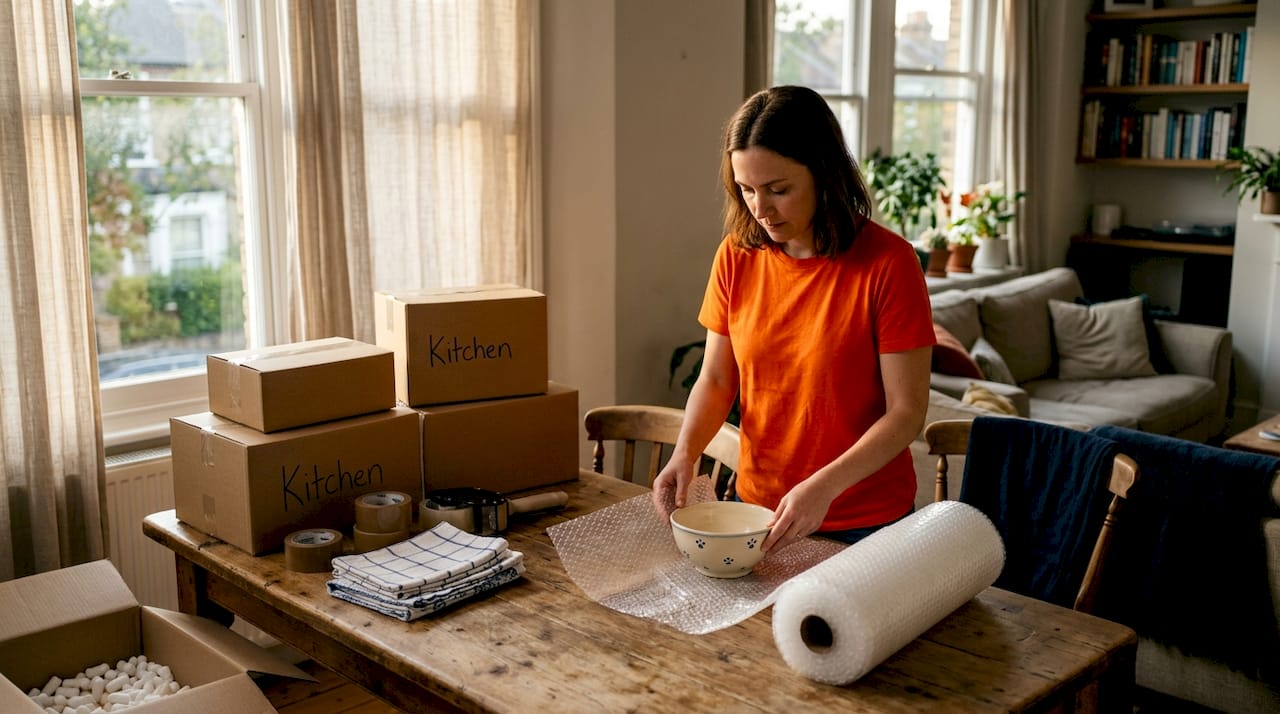
Strategic packing by weight is the single most overlooked step in DIY moving. Stewart Moving & Storage advises keeping small boxes to 30–40 pounds maximum, using medium boxes for general household contents, and reserving large boxes for lightweight bulky items such as duvets and cushions. This approach protects your back and keeps boxes manageable for a single person to carry.
Labelling is not optional. Mark every box with its destination room, a brief contents list, and a clear “FRAGILE” warning where needed. This speeds up unloading and prevents heavy boxes being stacked on top of delicate ones.
Estimated packing material costs
| Item | Approximate cost |
|---|---|
| Standard double-walled box | £1–£5 per box |
| Dish-pack box | £4–£8 per box |
| Bubble wrap roll (50 metres) | £8–£15 |
| Packing paper (25 sheets) | £3–£6 |
| Packing tape (6-roll pack) | £5–£10 |
Costs vary by supplier and quantity. Buying in bulk from a packaging wholesaler rather than a supermarket cuts the per-unit price considerably. Angi notes that careful calculation of box quantities based on home size prevents both over-ordering and running short on move day.
Pro Tip: Pack a clear plastic box or bag with your kettle, mugs, teabags, and phone charger last. Load it into the vehicle first so it comes out last and is immediately accessible when you arrive.
How do you load boxes efficiently without professional help?
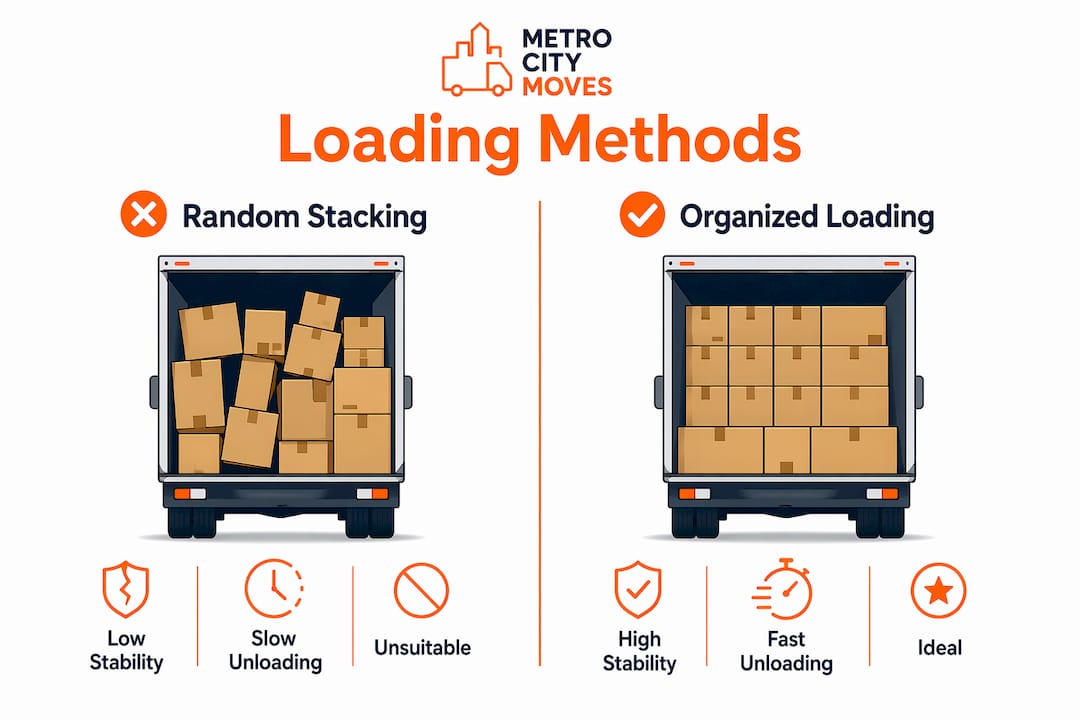
Loading boxes correctly is as much an engineering task as a physical one. U-Haul’s loading guidance is built around a simple principle: heaviest items go in first, lightest items go on top. Applying this to a box-only move means your books, kitchen equipment, and tool boxes form the base layer, with bedding, clothing, and lampshades sitting on top.
Follow this loading sequence for a stable, damage-free load:
- Place the heaviest boxes flat on the vehicle floor, pushed against the cab wall to keep the centre of gravity low and forward.
- Build stable rows across the full width of the vehicle, so boxes support each other laterally rather than leaning.
- Fill any gaps between boxes with rolled blankets, towels, or soft bags to prevent sideways movement during braking.
- Stack lighter boxes vertically on top, keeping the stack height consistent so nothing leans or topples.
- Secure each tier with tie-down straps or ropes looped through the vehicle’s anchor points. U-Haul confirms that vertical tiers secured this way also allow selective unpacking without disturbing the entire load.
- Load fragile boxes last, placing them on top and marking their position so unloaders know to handle them first.
Loading method comparison
| Method | Stability | Unloading speed | Suitable for |
|---|---|---|---|
| Random stacking | Low | Slow | Nothing |
| Weight-ordered rows | High | Moderate | Most box moves |
| Secured vertical tiers | Very high | Fast | Larger loads, long distances |
Pro Tip: Before closing the vehicle, do a firm push test on the top layer of boxes. If anything shifts noticeably, add more padding in the gaps before you drive.
What transport options do DIY movers have without a removal firm?
Choosing the right transport method is the decision that most affects your total cost. Ship2Storage positions micro moves as a distinct category from full household removals. Hiring a full removal lorry for a dozen boxes wastes money and space. Matching the transport method to your actual box count is the practical approach.
Your main options are:
- Man and van hire. A man and van service gives you a driver and a transit-sized vehicle for a few hours. This suits box-only moves of up to 30–40 boxes within London or nearby areas. You pack, they drive. Costs are significantly lower than a full removals booking.
- Portable container services. Companies like PODS deliver a container to your door, you fill it at your own pace, and they collect and deliver it to your new address or a storage facility. PODS recommends padding box bottoms and filling interiors fully to keep contents firm during transit. This method suits movers who need flexibility on timing.
- Self-drive van rental. Hiring a van from a company such as Enterprise or Europcar and driving it yourself is the lowest-cost option if you are comfortable driving a larger vehicle. You pay for the rental period, fuel, and any insurance top-up.
- Micro move services. Services like Ship2Storage handle small quantities of boxes without requiring you to rent a truck at all. This is the right fit for student moves, single-room relocations, or anyone moving only personal effects.
- Courier or parcel services. For very small quantities, sending boxes via a courier service such as Parcelforce or DPD can be cheaper than any vehicle hire. This works for non-fragile items that are not time-sensitive.
For a detailed cost comparison between van hire options and professional help, the man and van vs removal company guide breaks down exactly when each option makes financial sense.
What are the most common mistakes when moving boxes yourself?
Overweight boxes are the most frequent cause of both injury and damage on DIY moves. A box that exceeds 40 pounds becomes difficult to grip safely, especially on stairs. The solution is simple: use smaller boxes for dense items and distribute weight deliberately rather than filling whatever box is to hand.
Insufficient void fill is the second most common error. PODS emphasises that a padded box bottom and a fully filled interior create a cushioned module that absorbs the forces of acceleration and braking. A half-filled box collapses under weight from above and allows contents to shift violently during sharp braking.
Loading errors cause a different category of problem. Boxes stacked without lateral support lean and fall. Gaps in the load allow the entire stack to shift during cornering. Both scenarios result in crushed boxes and broken contents.
The most avoidable mistake in any DIY box move is loading in a hurry. A methodical 20-minute load takes the same time as a chaotic one but arrives intact.
Planning your unloading sequence before you drive is a step most people skip entirely. If you load boxes in a logical order and label them clearly by room, unloading becomes a directed process rather than a guessing game. You avoid re-stacking boxes at the destination, which saves time and reduces the risk of dropping something heavy.
When the move involves a long distance, multiple trips, or more than 50 boxes, a hybrid approach makes sense. You handle the packing and the secure storage side, and you bring in a man and van for the transport leg. This keeps costs down while removing the most physically demanding part of the process.
Key takeaways
Moving boxes without a removal firm is achievable for most people, provided packing, loading, and transport decisions are made deliberately rather than improvised on the day.
| Point | Details |
|---|---|
| Match box size to item weight | Use small boxes for heavy items and large boxes for light, bulky goods to protect your back. |
| Fill every void | Bubble wrap, towels, and packing paper prevent shifting and reduce breakages during transit. |
| Load heaviest boxes first | Place the heaviest boxes on the vehicle floor against the cab wall, then build upward with lighter boxes. |
| Choose transport by box count | Micro move services and man and van hire suit box-only moves better than full removal lorries. |
| Plan your unloading sequence | Label boxes by room before loading so unloading at the destination is directed and efficient. |
What I have learned from watching hundreds of DIY moves go wrong
Most people who attempt to move boxes without help underestimate one thing: the gap between packing well and packing correctly. Wrapping items in newspaper and hoping for the best is not packing. Packing is filling every cubic centimetre of a box so that nothing moves, the lid closes flat, and the box can bear weight from above without collapsing.
The second thing novice movers consistently get wrong is the loading order. They load whatever is nearest the door first, which usually means light, awkward items go in before the heavy base layer. The result is a load that shifts on every corner and arrives looking like it was shaken rather than transported.
What I find most telling is that the movers who do this well treat it like a logistics problem, not a physical task. They measure their boxes, calculate their vehicle space, plan their loading sequence on paper, and execute it in order. That approach takes an extra hour of planning and saves three hours of re-stacking and damage assessment at the other end.
The transport choice also matters more than most people realise. A man and van for a box-only move is almost always the right call if you are not comfortable driving a large vehicle. The cost difference between self-drive and a man and van in London is smaller than most people expect, and the reduction in stress is considerable.
My honest advice: spend as much time planning the load as you spend packing the boxes. The packing protects individual items. The loading protects the entire move.
— Far
Metrocitymoves can support your DIY move
Not every part of a self-managed move has to be done entirely alone. Metrocitymoves has been helping Londoners move since 2010, and a significant number of those moves are hybrid arrangements where the customer packs and Metrocitymoves handles the transport.
Whether you need a man and van for a box-only run across London, a professional house removal for a larger move, or secure storage while you coordinate dates, Metrocitymoves covers all 32 London boroughs with fixed-price quotes and full Goods in Transit insurance. Get in touch for a free quote and find out how much of the heavy lifting you can hand off without handing over the entire move.
FAQ
Can I move boxes without hiring a removal firm?
Yes. Box-only moves are a distinct category from full household removals, and services like man and van hire, portable containers, and micro move providers handle them without requiring a full removals booking.
How heavy should moving boxes be?
Stewart Moving & Storage recommends keeping small boxes to a maximum of 30–40 pounds. Heavier boxes increase injury risk and are harder to stack safely.
What is the cheapest way to transport boxes yourself?
Self-drive van rental is the lowest-cost option if you are comfortable driving a larger vehicle. For very small quantities, courier services such as Parcelforce can be cheaper than any vehicle hire.
How do I stop boxes shifting during transit?
Fill every void inside each box with bubble wrap, towels, or packing paper, then secure the loaded vehicle with tie-down straps between tiers. A box that does not rattle when shaken will not shift during transit.
When should I use a man and van instead of moving boxes myself?
Use a man and van when you have more than 20–30 boxes, are moving a long distance, or are not comfortable driving a transit-sized vehicle. The cost saving from self-drive rarely justifies the added stress for larger box-only moves.
Recommended
- How to Pack Fragile Items for Moving | Expert Guide | Metro City Moves
- How to Pack a Kitchen for Moving | Expert Tips | Metro City Moves
- Last-Minute Removals London 2026 | 7-Day Move Plan | Metro City Moves
- Moving House Checklist 2026 — Complete Week-by-Week Guide | Metro City Moves | Metro City Moves