
Packing & storage
Packing services in London, for the whole house or just the kitchen
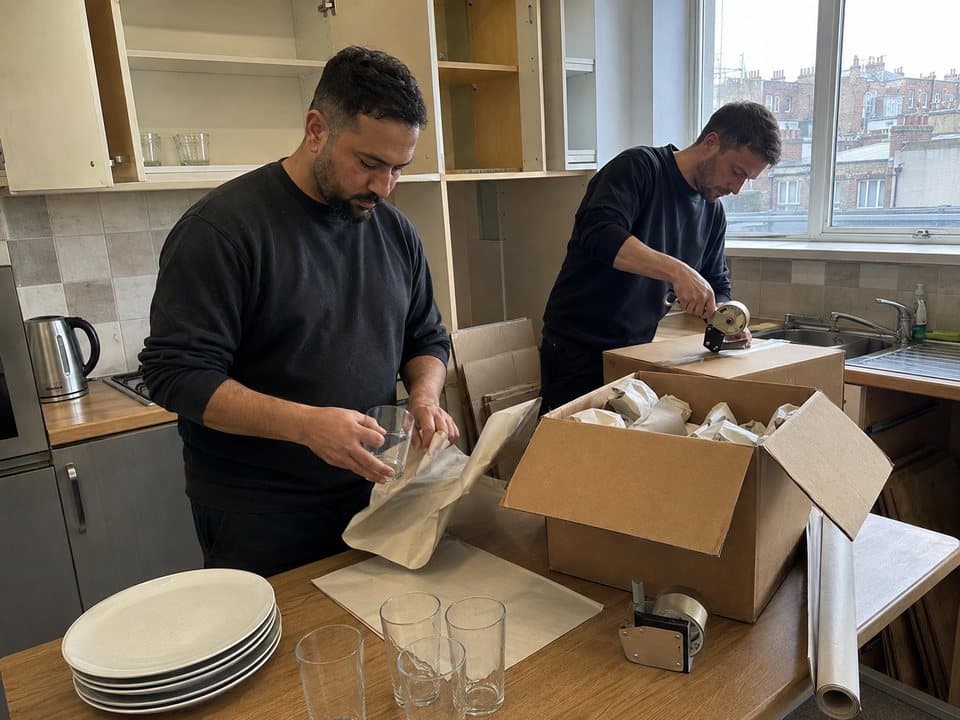
Packing is the part of a move people always underestimate, and it is the part that decides whether the day runs. A crew standing in a hallway waiting for the last three cupboards to be emptied is the most expensive thing on any moving day.
Best for
Full, part or fragile only
Takes
Longer than people expect
We cover
Every London postcode
What it costs
What packing services actually cost in London
Packing is priced by time and by materials, and both are driven by what is in the house rather than how many bedrooms it has. A minimalist three-bed can be quicker than a well-stocked one-bed, and it usually is.
How much there actually is
Not the room count. The bookshelves, the loft, the understairs cupboard and the garage are what decide the hours, and they are the four places nobody mentions when they ring up for a price.
The kitchen, which is half of it
Every item is a different shape, most of them break, and it is the room you cannot empty early because you are still eating. On a full pack the kitchen is routinely as long as the rest of the house put together.
Glass, china and anything framed
Mirrors, pictures, a glass table top and the good crockery are wrapped individually and boxed with the space filled properly. It is slower on the day and it is the reason things arrive intact.
Wardrobes, and whether clothes stay on hangers
Hanging wardrobe boxes are faster at both ends and cost more per box. Folded into cartons is cheaper and means an evening of ironing. Both are fine, they are just different numbers.
How much you have already done
A part pack is common and sensible: you do the books and the clothes, we do the kitchen, the fragiles and the loft. Tell us where you want the line and we price from there.
Whether you want unpacking as well
Unpacking is a separate half day and it is the one people cut first. It is worth pricing both so the decision is made with a number in front of you rather than at eight in the evening surrounded by boxes.
So what would yours cost?
Ten minutes on a video call and you will have it in writing. No obligation, and no number invented over the phone.
Before the day
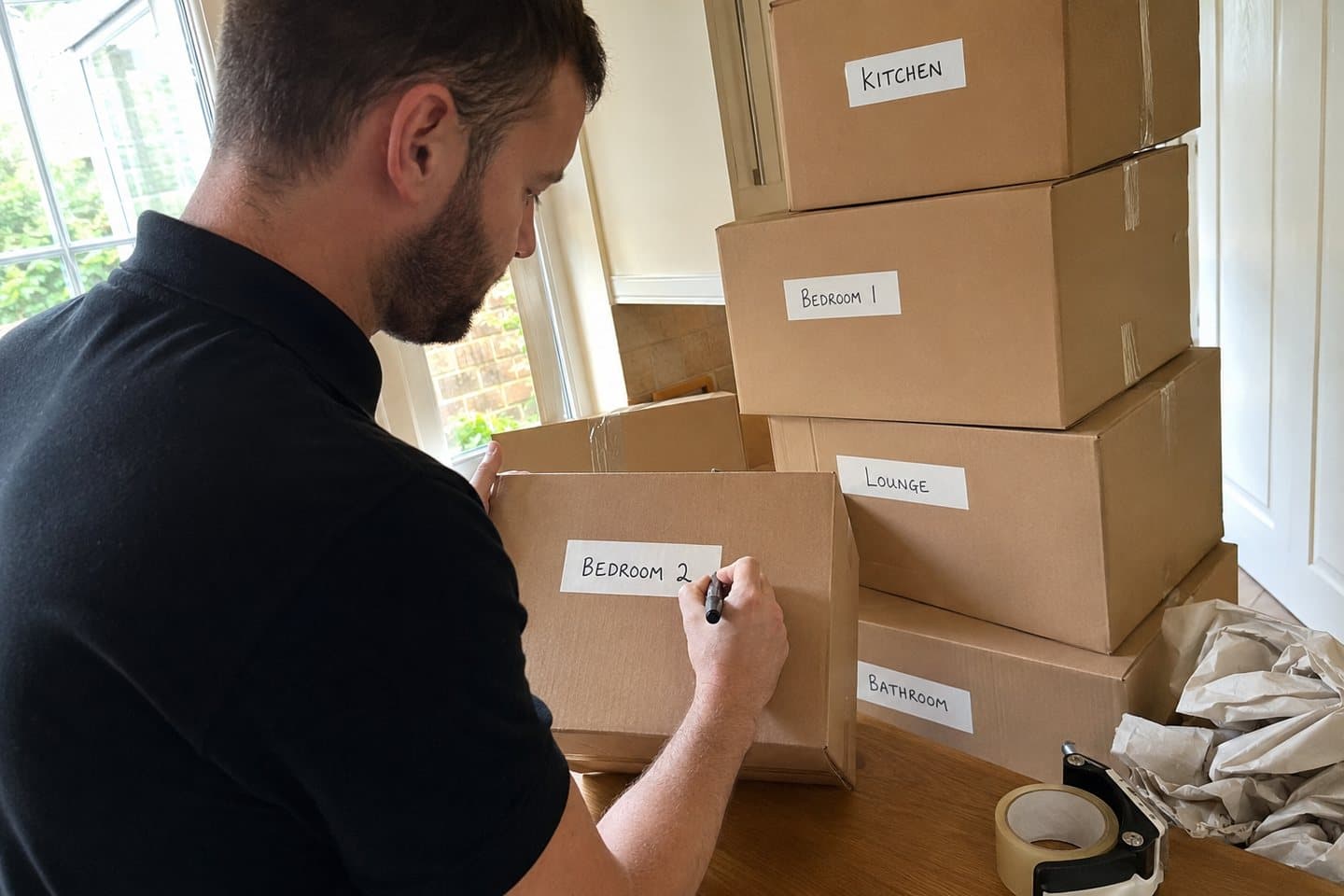
Everything gets labelled with the room it is going to
Not the room it came from. A box marked KITCHEN tells the crew nothing useful at the new address; a box marked KITCHEN — TOP CUPBOARDS, going to the room the new kitchen actually is, gets put down in the right place once.
Fragile boxes are listed as they are packed, so at the other end you know what was in each one without opening all of them. It matters most on the boxes you do not unpack for a month.
It costs nothing extra and it is the difference between unloading a van and spending a Sunday looking for the kettle.
On the day
How a packing job runs
Three things that happen on every job, before and after the lifting.
- 01
Materials arrive with the crew
Boxes, paper, tape and covers, brought on the day. You do not need to have sourced anything beforehand, and you are not left with a hallway of flat-packed cardboard for a fortnight.
- 02
Room by room, not everywhere at once
A room is finished, labelled and closed before the next one is opened. It keeps the house liveable while the packing happens, which matters if it is happening the day before you move.
- 03
The fragile boxes are listed
What went in which box, written down. It takes minutes and it is the thing people are most grateful for three weeks later.
The quote
What the price covers, and what it does not
Both lists go on the written quote, so there is nothing to discover afterwards.
Included
- Boxes, paper, tape and covers, brought with the crew on the day
- Packing room by room, labelled with the room it is going to
- Fragile items wrapped individually and boxed with the space filled
- A written list of what went into the fragile boxes
- Beds and flat-pack furniture dismantled where they have to come apart
Not included
- Aerosols, paint, solvents, petrol, gas cylinders or fireworks — these cannot travel
- Unpacking, unless you asked for it to be priced
- Taking the empty boxes and packaging away afterwards
- Anything gas: a cooker or gas appliance needs a Gas Safe engineer
From our Google profile
What people said about their move
Left on our Google profile. Every card links back to it, so you can read the rest — including any we would rather you did not.
Good experience with Metro City Moves. 4 bedroom house seemed bit difficult to move from London to Liverpool, but they planned well and successfully executed. Thank you.
Saqib AwanRead on Google, opens in a new tab
Before you book
Questions people actually ask
Do you bring the boxes?
Yes. Boxes, paper, tape and covers come with the crew. Tell us at the quote stage how much you want packed and the materials are priced with the job, so there is no separate shopping trip and no surprise at the end.
How long does packing a house take?
It depends far more on what is in it than on the number of bedrooms, which is why we look before we quote. What is reliable is that the kitchen takes about as long as everything else combined.
Can I pack some of it myself?
Yes, and most people do. A common split is that you handle books, clothes and the things you want to sort through, and we do the kitchen, the fragiles and the loft. Tell us where the line is and we price from there.
Will you pack the day before or on the day?
For anything bigger than a small flat, the day before. Packing and moving in the same day is possible but it makes for a very long one, and it is the arrangement that most often finishes in the dark.
What about documents, jewellery and medication?
Keep them with you. Passports, cash, jewellery, keys, chargers and anything you take daily should go in a bag that never enters the van. We will remind you, but it is the one part worth doing yourself.
Do you unpack as well?
We can, and it is priced separately because it is a separate visit. Get both numbers before you decide — people who skip it usually wish they had not.
Related reading
The things that catch people out
Parking, vans and packing — the rules read from the source, dated when checked.
- Guide
A moving house checklist for London, built around the dates
A moving house checklist built around London's real deadlines — the parking notice your borough demands, the ULEZ check, and what to do in the last week.
Read it - Guide
How to pack electronics for moving
Back up first, photograph the cables, remove the batteries, wrap each device in anti-static bubble wrap and keep every screen upright. The full order.
Read it - Guide
Moving office in London without losing a day of trading
What moving office in London actually involves — the building's rules at both ends, booking the goods lift, out-of-hours access, and the order to do it in.
Read it - Guide
Moving out of a London flat, and what the building decides for you
What decides how a London flat move goes — whether the lift can be booked, the turn on the stairwell, and where the van is allowed to stop while you carry.
Read it - Guide
Moving to Battersea: the two completely different moves it can be
Moving to Battersea is two jobs: a Nine Elms tower where the goods lift rules, or a Victorian terrace where Wandsworth charges £43.40 to hold the kerb.
Read it - Guide
Moving to Clapham: the flat share, the terrace, and the £156 you can avoid
Moving to Clapham usually means a converted Victorian terrace and a Lambeth bay suspension, where applying a few days late can add £156.31 to the same booking.
Read it
Get it priced properly
A survey first, then the number in writing. Answered at any hour.