What does a removals survey mean for your quote?

A removals survey is a professional pre-move inspection that converts a rough estimate into a fixed, reliable quote. A trained surveyor assesses your belongings, measures volumes in cubic feet or metres, and checks access at both your current and new address. The result is a written, fixed-price quote that removes the guesswork before moving day. The British Association of Removers (BAR) recommends pre-move surveys as standard industry practice, and Metro city moves offers both in-person and video formats to suit your circumstances. Surveys typically take 20–60 minutes depending on property size and method, with video surveys generally running 15–30 minutes for standard one-to-three bedroom homes.
Table of Contents
- What does a removals survey actually check?
- Why a survey matters for your quote and moving day
- What happens during an in-person survey, step by step
- How video surveys work and when to choose one
- How to prepare for your removals survey
- What to check in your written quote after the survey
- What are the risks of skipping a survey?
- Typical survey timelines and the cost factors that affect your quote
- How Metro city moves conducts removals surveys
- Key takeaways
- The mistake most people make before a removals survey
- Book a free survey with Metro city moves
- Further reading and authoritative sources
- FAQ
What does a removals survey actually check?
The survey goes well beyond counting boxes. A thorough surveyor works through every area of your home to build a precise picture of what needs moving and how.
Areas covered:
- Living rooms, bedrooms, and dining rooms
- Kitchen and utility rooms, including white goods
- Home offices and study spaces
- Lofts, garages, sheds, and outbuildings
- Any items in communal storage or external units
Beyond the room-by-room walkthrough, the surveyor records furniture dimensions, flags items that need dismantling before the move, and identifies anything requiring specialist packing, such as antiques, artwork, or fragile glassware. Access constraints at both addresses are assessed too: doorway widths, stair clearances, carry distances from the property to the vehicle, and parking availability. These practical measurements are the primary cause of unexpected waiting-time or extra-labour charges when they are missed at survey stage.
Pro Tip: Measure any unusually narrow doorways or tight staircase turns before the surveyor arrives. Sharing those figures upfront saves time and helps the surveyor plan the right equipment from the start.

Everything you plan to move must be visible and discussed during the survey. Hiding bulky items or forgetting the shed contents means the quote will not reflect the real job, and you may face additional charges on moving day.
Why a survey matters for your quote and moving day
The survey is the single thing that turns a guess into a fixed-price quote. Without one, a removal company is estimating blind, and that estimate is far more likely to change on the day.
Survey data determines three things directly: the size of the vehicle required, the number of crew members needed, and the specialist equipment to bring. When that data is missing, companies often allocate a standard resource that may be too small, forcing urgent and costly changes on moving day. A surveyed quote locks those resources in advance.
Common moving-day problems a survey prevents:
- A van that is too small, requiring a second trip
- Insufficient crew for heavy or bulky items
- Delays caused by unplanned dismantling or specialist packing
- Surprise charges for access difficulties the company was not warned about
- Disputes over what was and was not included in the original price
The survey also gives you a documented record of what was agreed. If a dispute arises about scope or cost, the written quote produced after the survey is your reference point. That paper trail matters, particularly for larger or more complex moves.
What happens during an in-person survey, step by step
An in-person survey is a structured walkthrough, not a casual chat. Here is what to expect.
- Booking and arrival. The surveyor confirms the appointment and arrives at your property, usually within a pre-agreed one-hour window.
- Introduction and scope. They ask about your moving date, destination address, and any known access issues at either end.
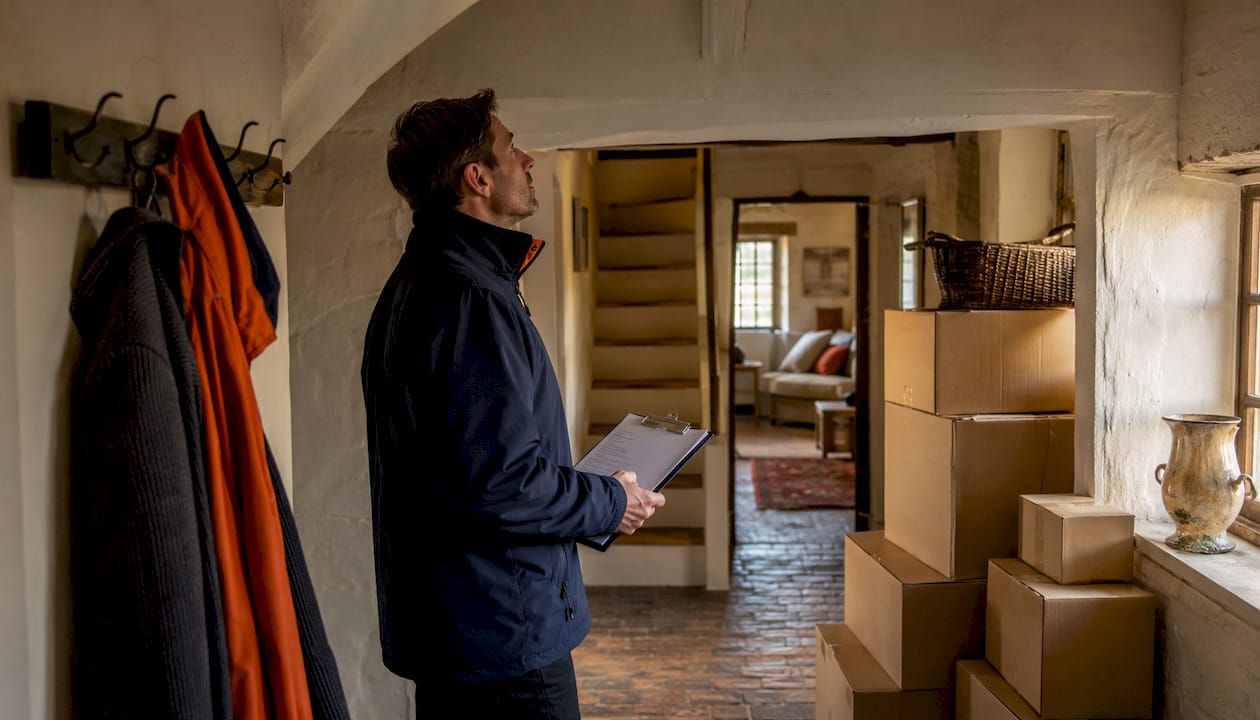
- Room-by-room walkthrough. Every room is assessed in turn, including lofts, garages, and outbuildings. The surveyor records item volumes, furniture dimensions, and anything needing special handling.
- Access checks. Doorway widths, staircase clearances, lift dimensions (if applicable), and carry distances from the property to the nearest loading point are all measured or noted.
- Parking and logistics. The surveyor confirms where the vehicle can park, whether a parking suspension permit will be needed, and how far the crew will need to carry items.
- Specialist items. Pianos, large wardrobes, gym equipment, and high-value items are flagged separately with notes on handling requirements.
- Questions and clarification. You can ask about packing services, insurance, storage, and anything else relevant to your move.
- Close and next steps. The surveyor confirms when you will receive the written quote, typically within 24 hours.
Timing guidance: a one-to-two bedroom flat usually takes 20–30 minutes; an average three-to-four bedroom house usually takes 30–45 minutes; larger properties or those with lofts, garages, and outbuildings can take up to 60 minutes or longer.
Pro Tip: If you live on a street with restricted parking, check in advance whether you need a temporary suspension permit from your local council. Letting the surveyor know the parking situation means vehicle access is planned correctly from day one.
How video surveys work and when to choose one
A video survey replaces the physical visit with a guided smartphone walkthrough. You carry your phone through the property while an experienced estimator talks you through what they need to see, room by room. The process typically takes 15–30 minutes for standard properties and produces the same outcome: a clear, fixed-price written quote.
| Factor | Video survey | In-person survey |
|---|---|---|
| Best for | 1–3 bedroom standard homes | Large properties, complex access |
| Duration | 15–30 minutes | 30–60 minutes or longer |
| Specialist items | Limited assessment | Full hands-on assessment |
| Access checks | Guided by you | Measured directly by surveyor |
| Quote accuracy | High for standard moves | Highest for complex moves |
Video surveys are often as accurate as in-person visits for straightforward moves, but complex moves — large properties, items needing specialist handling, or difficult access — benefit from a physical inspection.
How to run a successful video survey:
- Charge your phone fully and test your camera before the call.
- Start in the largest room and work systematically through the property.
- Open wardrobe doors and show the surveyor inside storage spaces.
- Show loft hatches, garage contents, and any outbuildings.
- Walk slowly around large furniture so dimensions are clear.
- Show doorways, staircase widths, and any tight turns.
- Step outside to show the nearest parking point and the building entrance.
Pro Tip: Good lighting makes a significant difference to what the estimator can assess. Open blinds, turn on lights in darker rooms, and avoid backlighting from windows when showing large items.
How to prepare for your removals survey
Preparation directly affects the accuracy of your quote. The more clearly the surveyor can see and understand your move, the more reliable the price will be.
Have these ready before the survey:
- Your preferred moving date and any flexibility around it
- The full address of your new property, including floor and access details
- Details of any parking restrictions at both addresses
- Lift dimensions if you are moving to or from a flat above ground floor
- A rough list of any items you plan to leave behind or dispose of before the move
Presenting specialist and high-value items:
Show the surveyor every item that is fragile, oversized, or particularly valuable. This includes artwork, antiques, musical instruments, gym equipment, and large appliances. Be specific about what you want packed by the removal company and what you will pack yourself. Informing the surveyor about specialist items is the only way to get those handling requirements priced into the quote rather than added as a surprise charge later.
Pro Tip: Photograph any item that is difficult to describe verbally, such as an unusually shaped sofa, a large mirror, or a piece of gym equipment. Showing the image during the survey removes ambiguity and helps the surveyor note the correct handling requirement.
What to check in your written quote after the survey
A written quote is only useful if it is complete. Before you accept it, check for the following.
Critical elements your quote must include:
- Total volume of items (in cubic feet or cubic metres) or a full item list
- Whether the price is fixed or hourly, and under what conditions it can change
- Dismantling and reassembly charges, or confirmation they are included
- Packing materials and labour, if you have requested a packing service
- Goods in Transit insurance cover and the level of liability
- Any additional charges for access difficulties, parking, or long carry distances
- Quote validity period (how long the price is guaranteed)
Questions to ask if anything is unclear:
- Is this a fixed price, or are there circumstances where it could increase?
- What insurance cover is included, and what is the claims process?
- Are packing materials charged separately?
- What happens if the move takes longer than planned?
- Is there a charge for storage if completion is delayed on the day?
Written quotes are typically delivered soon after the survey. If a quote arrives without a clear volume figure or a breakdown of what is included, ask for clarification in writing before you commit. Verbal assurances are not enforceable; written confirmation is.
What are the risks of skipping a survey?
Skipping a survey is a calculated risk. For most moves, it is not worth taking.
The main risks:
- An inaccurate price that increases significantly on moving day
- A vehicle that is too small, forcing a second trip at extra cost
- Insufficient crew for the actual volume of items
- Delays caused by access problems the company was not warned about
- Last-minute charges for specialist handling or packing not included in the original price
When skipping a survey is lower risk:
A very small move, such as a single room or a studio flat with no specialist items and straightforward access, can sometimes be quoted accurately without a physical or video survey. The same applies to a man and van booking for a handful of items. In these cases, a detailed written inventory submitted by the customer can be sufficient, provided the removal company is experienced and asks the right questions.
A note on paid surveys: Most professional UK removal companies offer pre-move surveys free of charge as part of their standard quoting process. If a company asks you to pay specifically for a basic pre-move survey, treat that as a red flag and ask for a clear explanation before proceeding. Free surveys are the norm, not the exception, among reputable firms.
Typical survey timelines and the cost factors that affect your quote
| Factor | Typical detail |
|---|---|
| In-person survey duration | typically ranges from a half hour to about an hour for an average home; longer for large properties |
| Video survey duration | usually 15–30 minutes for standard one-to-three bedroom properties |
| Written quote turnaround | Usually within 24 hours of the survey |
| Quote validity | Varies by company; ask directly |
Cost factors that most commonly change a quoted price:
- Access difficulty: narrow staircases, no lift, long carry distances, or restricted parking can add labour time and cost
- Specialist items: pianos, large antiques, gym equipment, and artwork require specific handling and often specialist equipment
- Packing services: full or partial packing adds materials and labour costs
- Storage requirements: if you need secure storage between properties, this is priced separately
- Long-distance moves: fuel, overnight accommodation for crew, and ferry costs for moves outside the M25 or to other parts of the UK
- Volume changes: adding items after the survey that were not included in the original assessment
Each of these factors can trigger a change in vehicle size, crew allocation, or both. A surveyed quote accounts for them in advance; an unsurveyed quote leaves them as unknowns until moving day.
How Metro city moves conducts removals surveys
Metro city moves has been carrying out pre-move surveys across London since 2010, covering all 32 boroughs and every postcode within the M25. The process is straightforward and designed to give you a clear, fixed price with no surprises.
Metro city moves’ survey process:
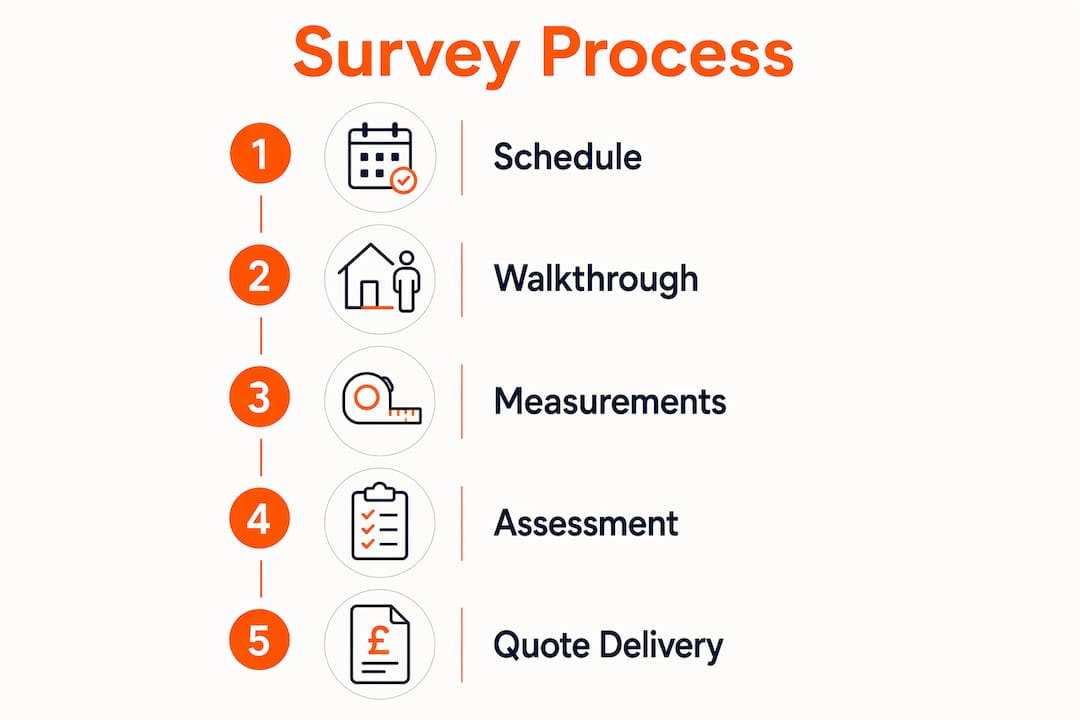
- Book your survey. Contact Metro city moves to arrange a free in-person or video survey at a time that suits you.
- Choose your format. For standard one-to-three bedroom properties, a video survey is often the quickest option. For larger homes, complex access, or specialist items, an in-person visit gives the most accurate result.
- The walkthrough. A trained surveyor works through every room, loft, garage, and outbuilding, recording volumes, flagging specialist items, and noting access details at both addresses.
- Access and logistics. Parking availability, staircase widths, lift dimensions, and carry distances are all confirmed during the survey.
- Written quote delivery. You receive a detailed, fixed-price written quote, typically within 24 hours of the survey.
What Metro city moves asks clients to prepare:
- Moving date and destination address
- Access details for both properties (floor, lift, parking)
- A list of any specialist or high-value items
- Details of any items to be left behind
London-specific advice from Metro city moves:
Parking in London requires planning. Double yellow lines, controlled parking zones, and estate restrictions can all affect loading times. Metro city moves advises clients to check whether a parking suspension permit is needed from their local borough council well in advance of moving day. In many London boroughs, permit applications require several days’ notice.
Pro Tip: For flat moves in London, confirm the lift dimensions with your building manager before the survey. Some service lifts have weight limits or restricted hours that directly affect how the crew plans the move.
Key takeaways
A removals survey is the professional pre-move inspection that converts a rough estimate into a fixed, reliable quote by assessing volumes, access, and specialist handling requirements at both addresses.
| Point | Details |
|---|---|
| What a survey is | A structured pre-move inspection that produces a fixed-price written quote based on real volumes and access. |
| Why it matters | Surveyed quotes are far less likely to increase on moving day; they lock in vehicle size, crew, and equipment. |
| In-person vs video | Video suits standard 1–3 bedroom homes (15–30 min); in-person is best for large or complex moves (30–60 min or longer). |
| How to prepare | Show every item, flag specialist goods, and confirm parking and access details at both addresses before the survey. |
| Metro city moves | Offers free in-person and video surveys across all 32 London boroughs, with written quotes typically within 24 hours. |
The mistake most people make before a removals survey
The most common error is treating the survey as a formality rather than a working consultation. People tidy up, close cupboard doors, and forget to mention the shed at the bottom of the garden. Then they wonder why the quote changes on moving day.
Volume is almost always underestimated. A standard three-bedroom house typically contains far more than most people expect once lofts, garages, and kitchen cupboards are included. Showing the surveyor everything, including the items you are still deciding whether to keep, gives you a more accurate quote even if you later reduce the load.
Access issues are the second most overlooked area. A tight turn on a staircase, a low ceiling in a garage, or a street with no parking within 50 metres of the front door all affect how long the job takes and what equipment is needed. These are not problems the surveyor will penalise you for; they are exactly what the survey is designed to surface.
Three practical tips worth applying before any survey:
- Walk through your property the day before and open every door, cupboard, and storage space. What you see is what the surveyor needs to see.
- Confirm the access situation at your new address, not just your current one. Surveyors assess both ends of the move, and missing details at the delivery address are just as disruptive.
- Ask directly about insurance for high-value items. Goods in Transit cover has limits, and specialist items such as antiques or artwork may need separate declaration. Get the answer in writing before you sign anything. For more on this, the role of insurance in house moves is worth reading before your survey appointment.
Book a free survey with Metro city moves
Metro city moves has been helping Londoners move since 2010, covering every borough and postcode within the M25. The survey process is free, straightforward, and designed to give you a fixed price you can rely on whether you choose a video call or an in-person visit.

For a house removal in London, the survey is where the planning starts. Metro city moves’ surveyors record everything: volumes, access, specialist items, and parking, so the written quote reflects the actual job. If you also need packing support or secure storage between properties, both can be discussed and priced during the same appointment. Get in touch to book your free survey and receive a fixed-price written quote within 24 hours.
Further reading and authoritative sources
These UK-focused resources are worth reading if you want more detail on pre-move surveys and how to get the most accurate quote.
- What is a pre-move survey? | Curtiss Removals — A clear, practical overview of what a pre-move survey covers, including access checks, specialist items, and how the survey produces an accurate quote. Useful for readers who want a second detailed explanation of the process.
- Do you need a home survey for a removals quote? | Direct Moves — Covers both in-person and video survey formats, explains when each is appropriate, and sets out what the written quote should include. Good for readers comparing survey methods.
- Video surveys for house removals | White and Company — A practical how-to guide specifically for video surveys, including what to show and how to prepare your property for the walkthrough.
- British Association of Removers (BAR) — The UK’s leading trade body for the removals industry. BAR membership is a recognised quality standard; their guidance on pre-move surveys reflects industry best practice.
FAQ
What does a removals survey involve?
A removals survey is a structured assessment of your belongings and property access, carried out before your move. A trained surveyor records volumes, flags specialist items, and checks access at both addresses to produce a fixed-price written quote.
Is a removals survey always free?
Most professional UK removal companies offer pre-move surveys free of charge as part of their standard quoting process. If a company charges specifically for a basic survey, ask for a clear explanation before agreeing.
How long does a removals survey take?
In-person surveys usually take 30–60 minutes for an average home; video surveys generally take 15–30 minutes for standard one-to-three bedroom properties. Larger or more complex properties may require longer.
Can I use a video survey instead of an in-person visit?
Yes, for standard one-to-three bedroom homes a video survey is often as accurate as an in-person visit. Larger properties, complex access situations, or moves involving specialist items generally benefit from a physical inspection.
What questions should I ask after my removals survey?
Ask whether the quote is fixed or subject to change, what Goods in Transit insurance is included, whether packing materials are charged separately, and how long the quoted price remains valid. Get all answers confirmed in writing.