The role of insurance in house moves explained

Insurance is the financial safety net that protects your belongings during a house move, covering damage, loss, or theft that your standard home policy may not fully address. Most people assume their existing contents insurance travels with them. The reality is more complicated. Standard homeowners and renters policies frequently exclude transit-related perils, and the liability coverage offered by removal firms is not the same as true insurance. Understanding the difference before moving day is the single most important step you can take to protect your possessions. Metrocitymoves operates as a fully insured removal company, which means your belongings are covered throughout every stage of the move.
What types of insurance cover belongings during a house move?
The role of insurance in house moves begins with understanding that there are four distinct types of cover, and they are not interchangeable. Each has different limits, costs, and exclusions that directly affect what you can recover if something goes wrong.
Released-value protection is the default liability cover offered by most removal firms. It sounds reassuring until you read the small print. Default mover liability pays only a fraction of an item’s actual value, often calculated per pound of weight. A £800 television weighing 20 lb could result in a payout of just £12 under this model. That figure illustrates why released-value protection is a liability limit, not a genuine insurance policy.
Full-value protection is the upgrade. Full-value protection is priced at roughly 1–2% of the declared value of your goods, and it covers repair or replacement at current market value. It costs more, but it closes the gap between what you own and what you can recover. Removal firms are typically required to offer this option, and you should ask for it directly rather than assuming it is included.

Homeowners or renters insurance transit cover is the third option. Your existing contents policy may extend to belongings in transit, but coverage is often limited to named perils such as fire or theft. Mishandling, dropping, or accidental breakage during loading and unloading are frequently excluded. Check your policy wording carefully before assuming you are covered.
Third-party moving insurance is a standalone policy purchased independently of your removal firm. It fills the gaps left by the other three options and can be tailored to cover specific high-value items. This is the most flexible option for anyone moving antiques, fine art, or specialist electronics.
| Cover type | What it pays | Typical cost | Best for |
|---|---|---|---|
| Released-value protection | Weight-based fraction of item value | Free (default) | Low-value general items |
| Full-value protection | Repair or replacement at market value | 1–2% of declared value | Most household moves |
| Homeowners transit cover | Named perils only (fire, theft) | Included in policy | Supplementary layer |
| Third-party moving insurance | Comprehensive, customisable | Varies by insurer | High-value or fragile items |
Pro Tip: Ask your removal firm in writing whether their quote includes full-value protection or only released-value cover. The answer will tell you immediately whether you need to arrange additional insurance.
How does insurance protect you, and what does it usually exclude?
House move insurance coverage typically applies across four stages: loading, transit, unloading, and temporary storage. Each stage carries different risks, and not all policies cover all four. Knowing which stages your policy addresses prevents nasty surprises when you file a claim.
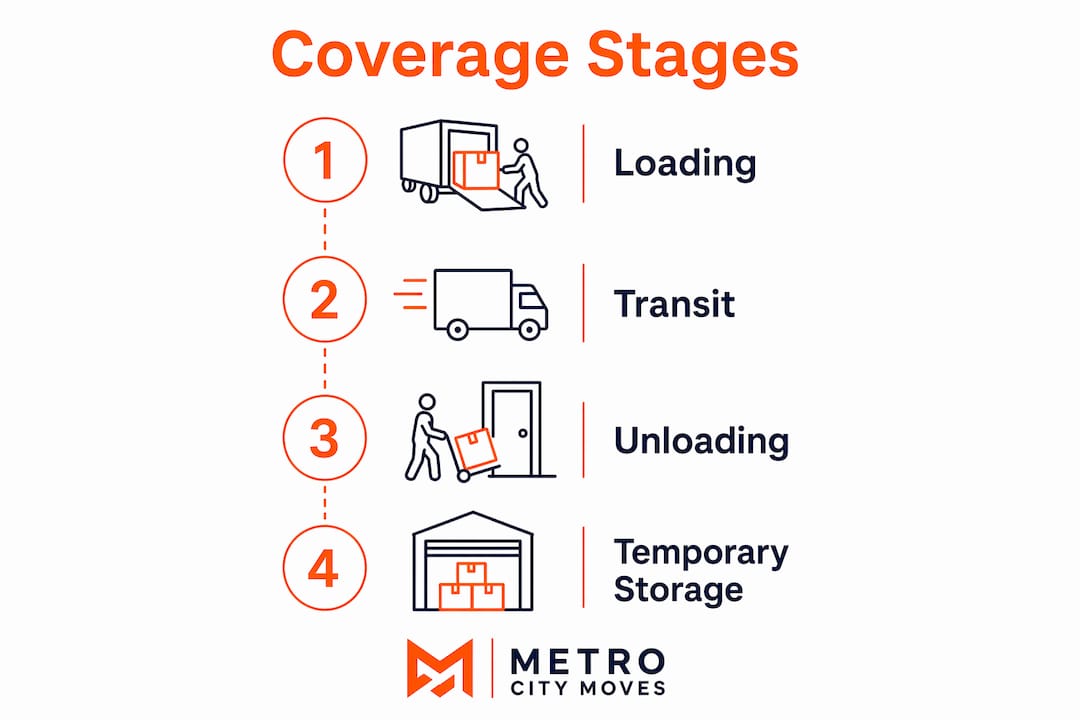
Coverage during transit is the most consistently included stage. Loading and unloading carry higher physical risk, and some policies treat these as separate events requiring explicit inclusion. If your goods go into secure storage between properties, check whether your policy extends to that period or whether you need a separate storage endorsement.
Common exclusions across most moving insurance policies include:
- Electronics packed by the owner rather than the removal firm
- Fragile items such as glassware, ceramics, and mirrors unless professionally packed
- Perishables, plants, and pets
- Owner-packed boxes, where the insurer cannot verify the packing standard
- Pre-existing damage to items before the move began
- High-value items such as jewellery, cash, or documents above a set limit
Some transit policies exclude entire categories including electronics, plants, and owner-packed boxes. This is why professional packing matters beyond just protecting your belongings physically. When Metrocitymoves packs your items, those goods are more likely to meet the insurer’s standard for a valid claim.
Pro Tip: If you pack any boxes yourself, photograph the contents before sealing them. This creates evidence of condition and contents that supports a claim if those boxes are damaged.
What are the practical steps to prepare for an insurance claim?
Successful claims depend on preparation that starts before the removal van arrives. Prompt written notification and detailed proof are the two factors that most determine whether a claim succeeds or fails. Notification deadlines can be as short as seven days after delivery, so acting quickly is not optional.
Follow these steps to give your claim the best chance of success:
- Create a written inventory before moving day. List every item being moved, including its estimated value and current condition. A spreadsheet works well. This document becomes your baseline evidence.
- Photograph and video everything. Walk through each room before packing begins and record the condition of furniture, appliances, and fragile items. Pay particular attention to items with existing minor damage so you can distinguish pre-existing marks from move-related damage.
- Retain original packaging and receipts. Insurers use purchase receipts to verify value. Original boxes for electronics and appliances also demonstrate that items were stored correctly before the move.
- Inspect all items on delivery day. Do not sign any delivery documentation as complete until you have checked your belongings. Note any visible damage on the paperwork before signing.
- Submit written notification within the policy deadline. Send your notification by email so you have a timestamped record. Claims scrutinised for timing are far more likely to succeed when the written record is clear and prompt.
- Obtain repair or replacement quotes. Do not dispose of damaged items before the claim is resolved. Get at least two written quotes for repair or replacement to support your valuation.
“Keeping packaging materials and claiming swiftly improves success rates significantly. The evidence you gather before and during the move is the foundation of any successful claim.”
Your removal firm’s claims process is the first escalation path. If that does not resolve the matter, you can escalate to the firm’s insurer directly. For disputes that remain unresolved, the Financial Ombudsman Service handles complaints against UK insurers.
Do I need additional moving insurance coverage?
The answer depends on the gap between what you own and what your current cover will actually pay out. Released value limits set a practical ceiling on recovery that rarely reflects the true value of household contents. If that ceiling is lower than the replacement cost of your most valuable items, you need additional cover.
Ask yourself these questions before deciding:
- What is the total replacement value of everything being moved?
- Does your homeowners or renters policy explicitly cover goods in transit, and which perils does it include?
- Does your removal firm offer full-value protection, and have you declared the correct value?
- Do you own any items worth more than £500 individually, such as jewellery, art, or specialist equipment?
- Are any items irreplaceable, where financial compensation would not fully address the loss?
A two-layer approach works best for valuable items. First, verify what your homeowners policy covers in transit. Second, purchase dedicated moving insurance or a specific endorsement to cover any gaps. This combination minimises the risk of a claim being denied or undervalued.
Discuss your specific situation with both your insurer and your removal firm before moving day. Metrocitymoves can confirm exactly what their Goods in Transit cover includes, which helps you identify any remaining gaps before you commit to a policy. You can also review the man and van vs removal company comparison to understand how insurance cover differs between service types.
What insurance changes should you make when moving to a new property?
Continuous cover is the goal. A gap between your old policy ending and your new one starting leaves your belongings unprotected, even if the gap is only a few hours. The timing of your insurance changes should mirror the legal transfer of ownership.
Keep your existing buildings and contents insurance active until the sale completes and keys are exchanged. Your solicitor will confirm the exact completion date. Start your new policy on the day of title transfer or move-in, whichever comes first. Do not cancel the old policy early to save money on the premium.
When setting up your new policy, adjust your coverage limits to reflect the new property. A larger home, a garden, or a garage changes your risk profile. Inform your insurer of any high-value items you want scheduled as named endorsements, particularly jewellery, watches, or specialist collections. Notify your insurer of your new address promptly. Failing to update your address can invalidate a claim on the grounds of material misrepresentation.
Pro Tip: Use your moving house checklist to schedule insurance updates alongside other administrative tasks. Treating insurance as a checklist item rather than an afterthought prevents the gaps that lead to uninsured losses.
Key takeaways
The most effective protection during a house move combines full-value protection from your removal firm with a verified transit endorsement from your home insurer, supported by thorough documentation before moving day.
| Point | Details |
|---|---|
| Default cover is inadequate | Released-value protection pays a fraction of item value; always ask for full-value protection instead. |
| Exclusions are common | Owner-packed boxes, electronics, and fragile items are frequently excluded from transit policies. |
| Documentation wins claims | Photograph belongings before the move and notify your insurer in writing within seven days of delivery. |
| Layer your cover | Check homeowners transit cover first, then supplement with dedicated moving insurance for high-value items. |
| Update policies promptly | Start your new home insurance on completion day and adjust limits to reflect the new property. |
Why I think most people get moving insurance completely wrong
The most common mistake I see is treating insurance as a box to tick rather than a decision to make. People accept the default released-value cover without reading what it actually pays, then feel blindsided when a damaged sofa results in a payout that covers barely a fraction of its replacement cost.
The second mistake is assuming that homeowners insurance travels seamlessly with your belongings. It often does not. The transit exclusions in standard contents policies are genuinely surprising, and most people only discover them when they try to claim.
What actually works is treating insurance as a two-stage process. Before the move, you audit what you own, check your existing policy wording, and fill the gaps with full-value protection or a third-party policy. During the move, you document everything and act quickly if something goes wrong. That preparation takes an hour or two. The alternative, discovering you are underinsured after a claim is denied, takes considerably longer to resolve.
Choosing a removal firm that carries comprehensive Goods in Transit cover is also part of the equation. It does not replace your own insurance decisions, but it does reduce the likelihood of needing to claim in the first place. Professional handling, proper equipment, and experienced crews lower the physical risk before insurance even enters the picture.
— Far
Metrocitymoves: fully insured removals across London
Metrocitymoves has been handling London house moves since 2010, and every job is covered by comprehensive Goods in Transit insurance as standard.
When you book professional house removals with Metrocitymoves, your belongings are handled by trained crews using proper equipment across all 32 London boroughs. The insurance cover applies from loading through to delivery, including any secure storage periods in between. You get a fixed-price quote upfront, full transparency on what the cover includes, and a team that treats your possessions with the same care they would give their own. Contact Metrocitymoves for a free quote and move with confidence.
FAQ
What is the difference between mover liability and moving insurance?
Mover liability, also called released-value protection, is a contractual limit on what a removal firm will pay per pound of damaged goods. Moving insurance is a separate financial product that covers repair or replacement at actual market value.
Do I need insurance for moving if I already have home contents cover?
Standard contents policies often exclude transit perils such as accidental damage during loading or unloading. Check your policy wording for transit exclusions before assuming you are fully covered.
How long do I have to make an insurance claim after a house move?
Notification deadlines can be as short as seven days after delivery. Submit written notification to your removal firm and insurer as soon as you identify damage or loss.
What items are typically excluded from moving insurance?
Common exclusions include owner-packed boxes, electronics, fragile items, plants, perishables, and high-value items such as jewellery above a set limit. Always read the policy schedule before moving day.
How much does full-value protection cost for a house move?
Full-value protection is typically priced at around 1–2% of the declared value of your goods. For most households, this represents a modest cost relative to the financial protection it provides.