
How flat removals differ from houses: what you need to know
The single biggest operational difference between flat and house removals is access. Building constraints — lift availability, narrow stairwells, long internal corridors and concierge procedures — add time, crew and cost that a straightforward house move with kerbside or driveway access simply does not face. Your immediate next step: book an onsite removal survey and check lift availability, parking permissions and your building’s permitted moving windows before you do anything else.
Table of Contents
- How do flat and house removals differ in terms of access?
- Does the volume of belongings change how you plan a flat or house move?
- Packing and furniture manoeuvring: what actually works in a flat
- How do you secure parking and loading access for a flat move in the UK?
- Timing, noise restrictions and neighbour etiquette in flats vs houses
- What drives costs up, and when is a professional service worth it?
- Insurance and liability in communal areas: what to check and document
- One-page prep checklist: who does what and when
- How Metrocitymoves approaches flat removals
- Key takeaways
- The detail most people underestimate about flat moves
- Metrocitymoves flat and house removal services
- Further reading and useful UK sources
- FAQ
How do flat and house removals differ in terms of access?
Access is where the flat removal process diverges most sharply from a house move. Houses typically offer direct kerbside or driveway access: the van parks close to the front door, the crew walks a short distance, and loading is straightforward. Flats introduce a chain of variables that can each add time independently.
Common access issues for flat moves:
- Lift availability and booking. Most modern blocks require you to book the service lift well in advance. Even when a lift exists, buildings often enforce weight or size limits and require a separate goods-lift booking. If another resident takes the slot, your move stalls.
- Narrow stairwells. In older conversions, stairwells are frequently too tight for a sofa carried flat. Items must be stood on end, tilted or partially disassembled before they can move.
- Long internal walks. A flat on the sixth floor of a large block may be 80–100 metres from the loading point once you factor in the car park, lobby and corridor. Every trip takes longer.
- Concierge and intercom procedures. Security gates, fob-access doors and concierge sign-in protocols add minutes per trip and can block the crew entirely if access is not pre-arranged.
Floor level matters directly. The higher the flat, the more time each carry takes, and the more trips the crew must make. A ground-floor flat with a short corridor behaves almost like a house; a fifth-floor flat without a goods lift is a different job entirely.
Pro Tip: Before your survey, photograph every pinch point: the lift interior (measure width, depth and height), stairwell width at the tightest bend, and the distance from the building entrance to your front door. A good removal company will use these measurements to plan crew size and equipment before they arrive.
Does the volume of belongings change how you plan a flat or house move?
Houses frequently contain lofts, garages, sheds and garden items that significantly increase total volume. A three-bedroom house with a loft and a garage can easily require a 7.5-tonne vehicle and a crew of four or five. A three-bedroom flat of equivalent living space usually has less total volume, but access constraints can still demand a larger crew or specialist equipment.
The table below sets out the key planning differences side by side.
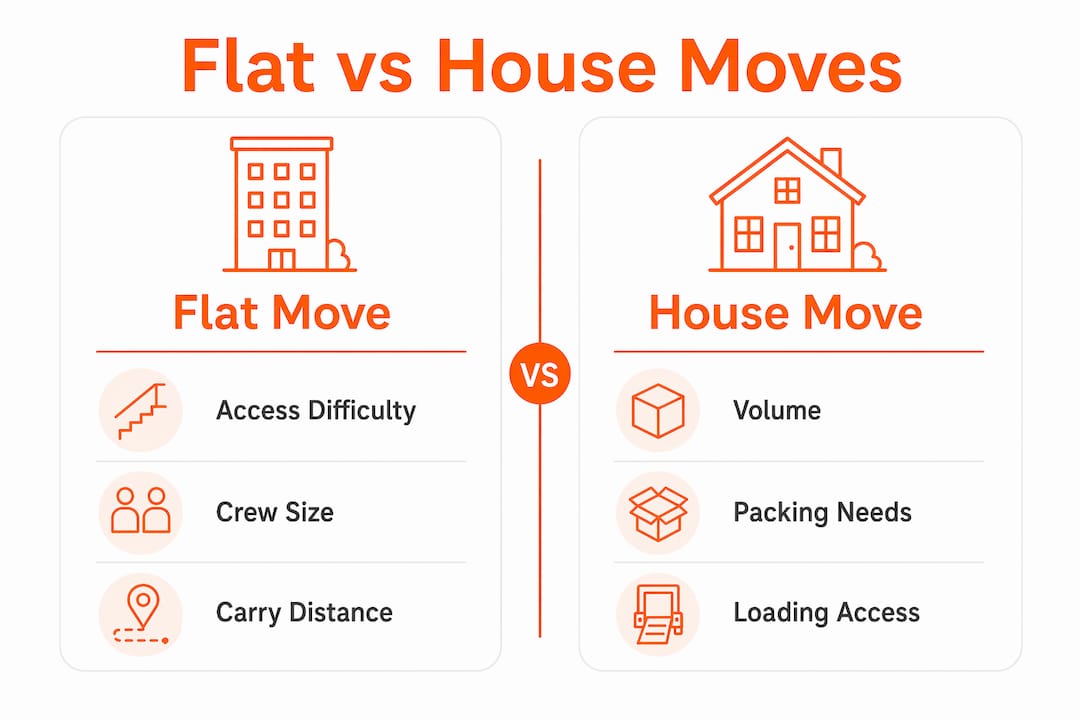
| Factor | Flat move | House move |
|---|---|---|
| Access difficulty | High: lifts, stairwells, corridors, concierge | Lower: kerbside, driveway, direct door access |
| Typical time on job | Longer per cubic metre due to carry distance | Faster loading where access is direct |
| Main cost drivers | Extra crew for stair carries, lift bookings, parking suspensions | Volume, van size, distance |
| Parking complexity | Often requires council suspension or loading-bay booking | Private driveway or unrestricted street parking common |
| Packing and disassembly | Higher: items must fit lifts and stairwells | Lower: larger items can often go straight to the van |
| Damage risk | Higher in communal areas; protective coverings needed | Lower; fewer shared surfaces to protect |
| Recommended van and crew | Smaller or medium van with larger crew for access; shuttle if needed | Larger vehicle, standard crew scaled to volume |
When an equivalent-volume flat move still needs a bigger crew than a house move, the reason is almost always repeated manual carries. Multiple short trips through stairwells or long internal routes require more hands than a same-volume house move with direct access, even when the total number of boxes is identical.
Packing and furniture manoeuvring: what actually works in a flat
Packing for a flat move rewards a different set of priorities than packing for a house. The guiding principle is carry-ability: every box and wrapped item needs to be manageable through a lift or up a stairwell.
- Use smaller boxes for heavy items. Books, kitchenware and tools should go in boxes no larger than 40 litres. Large boxes filled with heavy items are unsafe on stairs and too wide for many lift doors.
- Protect communal areas proactively. Wrap furniture corners and use blanket pads on banisters and door frames before the first item moves. Managing agents can charge for damage to shared surfaces.
- Disassemble before move day, not during. Bed frames, wardrobes and large desks should be broken down the evening before. Store all fixings in labelled zip-lock bags taped to the relevant piece of furniture.
- Identify tight-fit items early. Sofas, American-style fridge-freezers and large dining tables are the most common problem items in flat corridors. Measure the item’s diagonal and compare it against the stairwell width and lift door opening.
For houses, the packing priorities shift: garden furniture, loft boxes and garage items need weatherproof wrapping, and larger items can often be carried straight to the van without disassembly. The risk of damage in transit is generally lower because the carry distance is shorter and there are no shared surfaces to protect.
How do you secure parking and loading access for a flat move in the UK?
Many flat moves in the UK require a council parking suspension or a building loading-bay booking, and both take time to arrange. Parking suspensions are processed by the local council and typically need several working days’ notice; costs vary by borough. Leaving this until the week before your move is a genuine risk.
The practical sequence to follow:
- Contact your building manager or managing agent to confirm the move-day rules, permitted hours and whether a loading bay or goods lift needs to be reserved.
- Check your lease for any specific removal restrictions (some blocks prohibit weekend moves or require written notice).
- Apply to your local council for a parking suspension if no private loading bay is available. Do this at least two weeks before your move date.
- Confirm vehicle dimensions with your removal company and check whether a large lorry can legally stop at the entrance. If it cannot, plan for a shuttle using a smaller vehicle.
When a large lorry cannot reach the building, a 7.5-tonne vehicle or a shuttle arrangement using a medium van is often the practical solution. The shuttle adds time but avoids parking fines and keeps the move legal.
Pro Tip: Ask your removal company whether they handle the parking suspension application on your behalf. Many experienced London removal companies do this routinely and know the lead times for each borough.
Timing, noise restrictions and neighbour etiquette in flats vs houses
Flat moves operate within tighter windows than house moves. Managing agents commonly restrict moves to weekday hours (typically 8 AM to 5 PM or 9 AM to 6 PM) and prohibit weekend moves entirely in some blocks. Lift-booking slots are often fixed to two-hour windows, which means your removal crew must work to a tighter schedule than they would on a house move.
Steps to reduce friction with neighbours and building staff:
- Notify your neighbours in writing at least a week before the move, giving the date and approximate hours.
- Inform the concierge or building manager the day before to confirm access arrangements are in place.
- Prop open communal doors safely (using proper door stops, not furniture) to speed up the crew’s movement.
- Keep noise to a minimum in shared areas: no shouting between floors, and no heavy items dragged across communal floors.
Weather affects flat moves more than house moves because the carry distance from van to door is longer. Rain makes a 100-metre internal route significantly slower and increases the risk of wet boxes and slippery floors. Build extra time into your schedule if your move falls in autumn or winter.
What drives costs up, and when is a professional service worth it?
The cost drivers for a flat move differ from those for a house move, and some are easy to overlook when comparing quotes.
- Parking suspensions. Borough costs vary; apply early to avoid last-minute premium charges.
- Extra crew for stair carries. Repeated manual carries through stairwells require more hands than a same-volume house move.
- Shuttle fees. A second vehicle or additional trips add both time and cost.
- Longer loading times. Lift waits, long corridors and access procedures all extend the job.
- Packing service and protective materials. Communal areas require floor coverings and furniture wrapping that a house move may not need.
- Specialist equipment. Furniture hoists or stair-climbing trolleys add to the quote but reduce damage risk significantly.
DIY or man-and-van can be cost-effective for a small studio flat on a low floor with easy access. For a two-bedroom or larger flat on an upper floor, or anywhere access is restricted, a full professional removal service tends to be better value once you factor in van hire, insurance, fuel, the risk of damage to communal areas and the sheer physical effort of repeated stair carries. Hidden DIY costs add up quickly, and a damaged banister or scuffed communal floor can cost more than the saving on the removal fee.
Pro Tip: Get a written fixed-price quote that itemises parking, crew size and any shuttle or specialist equipment. An hourly rate that looks cheap can become expensive if the job runs long due to lift waits or access delays.
Insurance and liability in communal areas: what to check and document
Flat moves carry a specific liability risk that house moves do not: damage to shared communal areas. A scuffed wall in a private hallway is your problem; a scuffed wall in a communal stairwell can result in a charge from the managing agent or a deduction from a deposit.
Documents and evidence to request and create before move day:
- Written move permission from the managing agent, confirming the date, hours and any conditions.
- Proof of council parking suspension (if applicable), kept on the day in case of challenge.
- Timestamped photographs of all communal areas you will use: stairwells, lift interior, lobby and corridors. Take these the day before the move.
- Confirmation of your removal company’s insurance. Ask directly for evidence of Goods in Transit cover and public liability insurance. Both matter for a flat move: Goods in Transit covers your belongings; public liability covers damage to the building and shared areas.
Some managing agents require a refundable deposit against potential damage to communal areas. Check this in advance and confirm the amount in writing.
One-page prep checklist: who does what and when
Six or more weeks before
- Contact the managing agent to confirm move-day rules, permitted hours and lift or loading-bay booking requirements.
- Check your lease for removal restrictions.
- Book your removal company and request an onsite survey. An onsite survey is the single most reliable way to identify lift constraints, permit needs and realistic crew sizing.
Two to three weeks before
- Apply to the local council for a parking suspension if needed.
- Reserve the goods lift or loading bay with the building manager.
- Confirm vehicle dimensions with your removal company and agree on a shuttle plan if a large lorry cannot access the building.
- Measure and photograph the lift interior, stairwell width and corridor length. Share these with your removal company.
One week before
- Notify neighbours in writing of the move date and hours.
- Begin disassembling large furniture and packing heavy items into small boxes.
- Confirm all bookings: lift slot, parking suspension, removal company arrival time.
Move day
- Protect communal areas with floor coverings and door-frame padding before the first item moves.
- Photograph all communal areas before and after the move.
- Keep the concierge or building manager informed throughout the day.
Questions to ask your removal company on survey: Does the quote include parking suspension costs? What crew size is planned for the floor level and carry distance? Is a shuttle or hoist needed? What Goods in Transit and public liability cover is in place?
How Metrocitymoves approaches flat removals
Metrocitymoves has been handling flat removals across London since 2010, covering all 32 boroughs and every postcode within the M25. The operational approach for flat moves is built around the variables that cause delays: access, permits and carry distance.
Every flat move starts with an onsite survey and a written, fixed-price quote. The survey identifies lift booking requirements, confirms whether a shuttle or hoist is needed, and determines the right crew size for the floor level and carry distance. Protective floor coverings and furniture padding are standard on all flat moves to protect communal areas.
Trust signals you can verify:
- Public liability insurance and Goods in Transit cover on every job.
- Specialist high-rise equipment, including stair-climbing trolleys and furniture hoists where needed.
- Experience managing council parking suspensions across London boroughs, with knowledge of typical lead times by area.
- Written quotes that itemise crew size, vehicle type, parking and any shuttle arrangements, so there are no surprises on the day.
For flat moves in East London specifically, Metrocitymoves’s East London flat removal team has direct experience with the estate and high-rise access patterns common in that area.
Key takeaways
Flat removals are more complex per cubic metre than house moves because access constraints, not volume, drive the time and cost.
| Point | Details |
|---|---|
| Access drives complexity | Lifts, stairwells and long corridors increase loading time and crew needs beyond what volume alone would suggest. |
| Parking needs early action | Council parking suspensions require several working days’ notice; apply at least two weeks before your move date. |
| Crew size follows carry distance | Repeated stair carries need more hands than a same-volume house move with direct kerbside access. |
| Document communal areas | Timestamped photos before and after the move protect you from disputed damage charges in shared spaces. |
| Metrocitymoves surveys first | Metrocitymoves provides an onsite survey and written fixed-price quote for every flat move, covering permits, crew size and shuttle needs. |
The detail most people underestimate about flat moves
The planning advice for flat moves tends to focus on the obvious: book the lift, sort the parking. What catches people out is the cumulative effect of small delays. A lift that is shared with other residents, a corridor that requires items to be turned sideways, a concierge who was not told about the move: none of these is a crisis on its own, but together they can add two or three hours to a job that looked straightforward on paper.
The clients who have the smoothest flat moves are the ones who treat the carry distance as the primary variable, not an afterthought. Once you know the exact route from van to front door, every other decision follows: crew size, vehicle choice, whether a shuttle is needed, how long to book the lift for. That single measurement, taken during a proper survey, is worth more than any amount of general advice.
The other thing worth saying plainly: a flat move on an upper floor is physically demanding work. Removal crews who do this regularly are worth the fee, not just for the speed but for the care they take with communal surfaces. A scuffed banister or a damaged lift panel can cost more to put right than the difference between a professional quote and a man-and-van rate.
Metrocitymoves flat and house removal services
Flat moves in London come with a specific set of complications that a generic removal service is not always equipped to handle. Metrocitymoves is built for exactly this: high-rise access, council permit coordination, specialist equipment and a fixed-price quote that accounts for every variable before the van arrives.
The process starts with an onsite survey, not a rough estimate over the phone. The survey confirms lift booking requirements, carry distance, crew size and whether a shuttle or specialist equipment is needed. That information goes into a written quote with no hidden charges for parking, extra crew or access delays.
Services include full packing, protective floor coverings for communal areas, Goods in Transit and public liability insurance, and secure storage if you need to move in stages. For house moves, the same fixed-price approach applies.
Request your onsite survey or get an instant quote for your flat removal in London today.
Further reading and useful UK sources
- GOV.UK: moving home — the official government page covering practical steps when moving, including council tax, utilities and address changes.
- Apartment Moving 101 (iMove UK) — practical guidance on lift bookings, building rules and packing priorities specific to flat moves.
- Moving day logistics checklist (Oxfordshire Guardian) — a step-by-step UK move-day checklist covering lift reservations, vehicle confirmation and slot bookings.
- London flats and estate access logistics (Compare the Man and Van) — covers lift booking windows, weight limits and access-specific planning for London estate and high-rise moves.
FAQ
How do flat removals differ from house removals?
Flat removals are more complex because of building access constraints: lifts, stairwells, long corridors and concierge procedures all add time and crew requirements that a house move with kerbside access does not face.
Is it worth buying a flat instead of a house?
That depends on budget, location and lifestyle priorities. Flats typically cost less to buy in London but may come with service charges and lease considerations; houses generally offer more space and no shared-area obligations.
What do removal companies typically not take?
Most removal companies will not transport hazardous materials (paint, gas canisters, certain cleaning products), plants, or items that cannot be safely secured in a van. Ask your removal company for a full exclusions list when booking.
Are flats harder to sell than houses?
Flats can be harder to sell in some markets, particularly leasehold flats with short leases or high service charges. Houses tend to attract a broader pool of buyers, though location and condition remain the primary factors.
When should you hire a professional removal company for a flat move?
For any flat above the ground floor, any two-bedroom or larger flat, or anywhere access is restricted, a professional removal service is usually better value than DIY once you account for van hire, insurance, the risk of damage to communal areas and the physical demands of repeated stair carries.
Recommended
- Flat Removals London | High-Rise & Apartment Specialists | Metro City Moves | Metro City Moves
- Flat Removals East London | High-Rise, Apartments & Conversions | Metro City Moves
- Flat Removals South London | High-Rise, Apartments & Conversions | Metro City Moves
- Flat Removals Barnet | High-Rise, Apartments & Conversions | Metro City Moves