
How to move to a new flat cheaply: a practical guide

The cheapest practical way to move to a new flat is straightforward: reduce what you move, self-pack with low-cost materials, book a midweek off-peak slot, and use a man-and-van or a targeted flat removal service for the heavy or awkward items. For a 1-bed flat, average removal costs run about the typical range; a 2-bed usually costs a bit more. Do those three things well and you can keep your total spend well under £500 for a small local move.
Your immediate next steps:
- Estimate your volume — count rooms and large items to decide whether you need a small van, a man-and-van, or a full removal team.
- Book an off-peak date — midweek, mid-month slots are consistently cheaper than Fridays, weekends, and month-end dates.
- Get at least three itemised quotes — or contact Metro city moves for a flat-specific estimate that includes any stair, lift, or parking considerations.
Table of Contents
- What does it really cost to move to a new flat?
- Declutter first: the single biggest way to cut your moving costs
- Where to get free or cheap boxes and packing materials
- Timing and logistics: when to move and how to sort parking
- Man-and-van, DIY hire, or full removal: which saves most?
- High-rise and flat-specific issues that cost people money
- Week-by-week checklist: what to do from six weeks out to moving day
- How Metro city moves helps customers cut costs
- Key takeaways
- The part most guides skip over
- Metro city moves: flat removals built for London budgets
- FAQ
- Useful UK sources and where to read more
What does it really cost to move to a new flat?
Most people budget for the van and forget everything else. The removal quote is just one part of your overall moving budget. Costs typically increase with property size and whether full packing services are used.
Source: MovingCost.co.uk (2026)
Beyond the removal quote, the costs that catch people out include:
- Deposit and overlap rent — if your new tenancy starts before your old one ends, you may pay rent on both properties for a week or more.
- End-of-tenancy cleaning — many landlords require a professional clean to release your deposit; budget £100–£200 for a 1-bed.
- Packing materials — branded removal boxes and bubble wrap from a removals company add up fast; self-sourcing cuts this significantly.
- Parking permits and loading bays — London boroughs charge for temporary suspensions; costs vary but are typically £50–£100 per day.
- Short-term storage — if there is a gap between move-out and move-in, secure storage avoids the cost of a second van trip.
- Insurance — check whether your contents insurance covers goods in transit; if not, ask your removal company about Goods in Transit cover.
Pro Tip: Add a contingency of at least 10–15% on top of your total estimated budget. Unexpected stair surcharges, a delayed key handover, or a last-minute parking permit can each add £50–£100 without warning.
For a domestic move, relying only on the van quote risks missing deposits and overlap rent entirely. It’s important to build the full picture before committing to a date.
Declutter first: the single biggest way to cut your moving costs
Decluttering before you pack is the highest-return action you can take. Reducing your load from a 3-bed volume to a 2-bed volume can drop your removal quote by several hundred pounds, shrink your van size, and cut the time your crew spends on the job.
How to work through it:
- Start 6–8 weeks before your move date, room by room.
- Apply a simple rule: if you have not used it in the last 12 months and it has no genuine sentimental value, it goes.
- Evaluate large furniture separately — measure doorways and corridors at the new flat before deciding whether to take a sofa or wardrobe.
- Sort items into four piles: sell, donate, recycle, and dispose.
- List sellable items on Facebook Marketplace or Gumtree at least four weeks out — furniture and appliances move quickly when priced fairly.
- Book a charity collection for donations; many UK charities (British Heart Foundation, Emmaus) collect large items free of charge.
- For hazardous items (paint, batteries, old electronics), check your local council’s collection or drop-off points — these cannot go in a standard removal van.
The sell pile often surprises people. A few pieces of furniture, a box of books, and some kitchen appliances can realistically cover part of your removal costs. Price items to move quickly rather than holding out for top price; the saving on van space usually outweighs a slightly lower sale price.

Where to get free or cheap boxes and packing materials
Buying branded removal boxes from a removals company is one of the easiest ways to overspend on a move. A professional packing service for a 3-bed property can add substantial cost on top of the removal fee — the average all-in price for removal plus packing is £1,575. Self-packing with sourced materials costs a fraction of that.
Reliable sources for free or low-cost boxes:
- Supermarkets — ask at the customer service desk or visit early morning when deliveries have just been unpacked; banana and wine boxes are particularly sturdy.
- Off-licences and wine merchants — bottle boxes are small, strong, and ideal for heavy items like books.
- Bookshops — often have clean, uniform boxes they are happy to give away.
- Freecycle and Facebook Marketplace — search “moving boxes” locally; people who have just moved are usually keen to pass them on quickly.
- Community groups and Nextdoor — post a request a few weeks out and you will often have more boxes than you need.
- Bulk online suppliers — if you need a specific size or quantity, buying a bundle from a packaging supplier is still far cheaper than removal-company rates.
Packing shortcuts that save money:
- Use towels, bedding, and clothing to wrap fragile items instead of buying bubble wrap.
- Pack books in small boxes only — large boxes of books are too heavy to carry safely and risk splitting.
- Label every box with its destination room and a brief contents note; this saves time on moving day and reduces the risk of breakages from mishandling.
- Bundle small items by room in labelled bags before boxing them.
Pro Tip: Never pack a box you cannot lift comfortably yourself. Overloaded boxes are the most common cause of dropped items and back injuries on moving day — and an injured helper costs you far more than a second box.
Timing and logistics: when to move and how to sort parking
The date you choose has a direct effect on your quote. Moving midweek and in quieter months can reduce removal prices noticeably; Fridays, Saturdays, month-end dates, and bank holidays carry consistent premiums because demand spikes. January, February, and mid-month weekdays are typically the cheapest slots.
Logistics checklist before moving day:
- Book the lift — contact your building management at least two weeks out to reserve the service lift for your move window. Many buildings limit lift use to specific hours.
- Apply for a parking suspension — in London, most boroughs require at least five working days’ notice for a temporary parking bay suspension. Apply through your council’s website; costs vary by borough.
- Request a loading bay — if your building has a designated loading area, confirm availability and any time restrictions with the concierge or management company.
- Notify building management — some buildings require written notice of a move and may charge a refundable deposit against lift or corridor damage.
- Confirm access at both ends — check the same details for your new building, not just the one you are leaving.
Common surcharges to avoid:
- Waiting time — if your removal crew arrives and cannot access the building or load the van, most companies charge by the half-hour. Have keys, codes, and contacts ready.
- Stair surcharges — carrying items up or down multiple flights without a lift adds time and cost; confirm stair access at both properties in advance.
- Parking fines — a van parked on a yellow line while waiting for access can result in a fine that wipes out any saving from a cheap quote.
Offering flexible move dates rather than a single fixed day often produces noticeably cheaper bids from drivers. If your tenancy allows a few days’ flexibility, use it.
Man-and-van, DIY hire, or full removal: which saves most?
The right choice depends on your property size, access, fragile items, and how much time you have. Here is a practical decision framework:
- DIY van hire suits a studio or 1-bed move with straightforward access, no fragile or heavy items, and at least two able-bodied helpers. It is the lowest-cost option but carries the highest personal risk — damage to goods is your responsibility.
- Man-and-van is the best value for most 1-bed and 2-bed flat moves. You get a driver, a vehicle, and typically one helper; you do the packing. For small moves in London, this is usually the most cost-effective professional option.
- Full removal service makes sense for 3-bed-plus moves, high-rise flats with complex access, fragile or high-value items, or when time is tight. The cost is higher, but so is the protection.
| Option | Best for | Key advantage | Key risk |
|---|---|---|---|
| DIY van hire | Studio/1-bed, simple access | Lowest cost | No insurance, physical effort |
| Man-and-van | 1–2 bed flat, local move | Good value, professional driver | Limited crew for large volumes |
| Full removal service | 3-bed+, high-rise, fragile items | Insured, efficient, less effort | Higher cost |
When getting multiple quotes, always ask for an itemised breakdown. Request confirmation of Goods in Transit insurance, and ask directly whether stair or parking surcharges apply. A low headline quote with hidden extras can end up costing more than a slightly higher all-in price.
For guidance on which option fits your situation, Metro city moves has a detailed man-and-van vs removal company comparison that walks through the decision clearly.
High-rise and flat-specific issues that cost people money
Flat moves carry risks that house moves do not. Narrow corridors, shared lifts, concierge sign-off requirements, and building management rules can all add cost if you have not planned for them.
The most common flat-specific surprises:
- Lift damage charges — buildings often require protective padding in the lift during a move. If you do not arrange this, you may be charged for any marks or damage.
- Stair surcharges — if the lift is unavailable or too small for large items, carrying up stairs takes significantly longer and most removal companies charge for it.
- Concierge or management fees — some buildings charge a refundable deposit or an admin fee for move-in and move-out coordination.
- Narrow corridor restrictions — a three-seat sofa that fits your living room may not fit around the stairwell or through the flat door. Measure before moving day.
- Leasehold paperwork — if you are buying rather than renting, leasehold flats carry service charges, ground rent, and major works contributions that can affect your overall moving budget.
Measurement checklist:
- Measure the width and height of all doorways at both properties.
- Measure the lift interior dimensions (width, depth, height) and the lift door opening.
- Photograph access routes, stairwells, and any tight corners.
- Check the dimensions of any large furniture before assuming it will fit.
Pro Tip: A short site survey before moving day costs nothing but time and can save you a stair surcharge, a damaged lift, or the cost of dismantling furniture on the spot. Metro city moves can advise on access during the quoting process.
Week-by-week checklist: what to do from six weeks out to moving day
6–8 weeks before:
- Declutter every room; list items for sale immediately.
- Research removal options and request at least three itemised quotes.
- Confirm your move-out and move-in dates with both landlords or agents.
- Start collecting free boxes from supermarkets and community groups.
- Notify your employer, GP, bank, DVLA, and HMRC of your upcoming address change.
2–4 weeks before:
- Book your removal company or van hire; confirm the date in writing.
- Apply for parking bay suspensions at both addresses.
- Contact building management at both properties to book lift access.
- Begin packing non-essential items (books, seasonal clothing, decorative items).
- Arrange utility transfers — contact your energy, broadband, and water providers to transfer or close accounts on the correct date to avoid overlap charges.
- Confirm contents insurance covers goods in transit.
Moving day:
- Prepare refreshments and snacks for helpers — it reduces the temptation to order expensive takeaways and keeps energy levels up.
- Assign one person to manage keys, access codes, and building contacts at each end.
- Do a final walk-through of the old flat before the van leaves; check cupboards, loft spaces, and meter readings.
- Photograph the condition of both properties on arrival and departure.
- Confirm parking is clear and the lift is booked before the van arrives.
Meal planning on moving day is worth a moment’s thought. Bringing your own refreshments can save on costly takeaways and keep helpers energized.
How Metro city moves helps customers cut costs
Metro city moves has been handling flat moves across all 32 London boroughs since 2010, and the team sees the same avoidable costs come up repeatedly. Three practical examples show how the right service choice makes a real difference.
Scenario 1: Man-and-van hybrid for a 1-bed move A customer moving a 1-bed flat in Hammersmith self-packed everything, booked a midweek man-and-van slot, and used Metro city moves for the heavy items only (a large wardrobe and a washing machine). Total removal cost stayed well below the standard 2-bed average because the volume was reduced and the date was off-peak.
Scenario 2: Site survey preventing a stair surcharge A customer moving into a 4th-floor flat in Croydon with no working lift called Metro city moves for a quote. The team flagged the stair situation during the quoting call, priced it correctly upfront, and the customer avoided a surprise surcharge on moving day. Transparent, itemised quoting is how Metro city moves operates.
Scenario 3: Combined rubbish removal and move A customer with a significant amount of furniture to dispose of before moving booked Metro city moves’ rubbish removal service alongside the flat removal. Clearing the unwanted items first reduced the van size needed for the actual move, saving on the removal cost overall.
Metro city moves services relevant to budget flat movers:
- Flat removals with high-rise and access expertise
- Man-and-van for 1–2 bed local moves
- Packing service (full or partial, so you only pay for what you need)
- Secure storage to bridge a gap between tenancies
- Rubbish removal to reduce volume before the move
- End-of-tenancy cleaning to protect your deposit
Pro Tip: Booking early and offering two or three possible dates gives Metro city moves more flexibility to offer a competitive price. Last-minute bookings on peak dates are always more expensive.
For student and low-budget movers, the same principles apply: reduce volume, self-pack, and use targeted professional help only where access or weight makes DIY genuinely risky.
Key takeaways
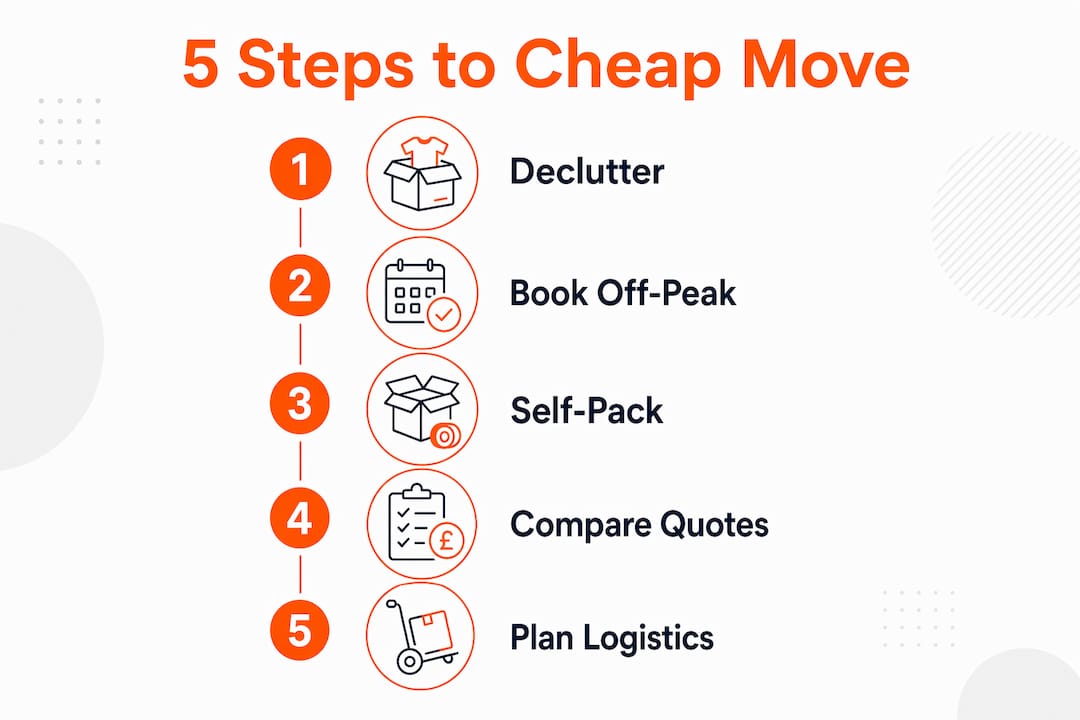
Moving to a new flat cheaply comes down to five decisions: declutter aggressively, book off-peak, self-pack, check access in advance, and get itemised quotes before committing.
| Point | Details |
|---|---|
| Declutter first | Reducing your load can drop your removal quote by hundreds of pounds and shrink your van size. |
| Book off-peak | Midweek, mid-month slots are consistently cheaper; avoid Fridays, weekends, and month-end dates. |
| Self-pack to save | A professional packing service for a 3-bed costs around £1,575; sourcing free boxes and packing yourself saves most of that. |
| Check flat access | Measure doorways, lift dimensions, and stairwells before moving day to avoid stair surcharges and damage charges. |
| Metro city moves | Get an itemised flat-specific quote covering access, parking, and any stair or lift considerations before you book. |
The part most guides skip over
There is a tendency in budget moving advice to treat the removal quote as the only variable worth controlling. It is not. The deposit overlap, the end-of-tenancy clean, the parking permit, and the last-minute takeaway order for helpers collectively often exceed the saving you worked hard to achieve on the van price.
The readers who genuinely move to a new flat cheaply are not the ones who found the lowest van quote. They are the ones who reduced their volume before they called anyone, sorted their building access two weeks out, and built a realistic total budget that included the cleaning, the permit, and a contingency. The removal quote is the easy part. The hidden costs are where most budgets fall apart.
Metro city moves is transparent about this. The team will tell you upfront if a stair surcharge applies, if a parking suspension is needed, or if a smaller service would suit your volume better. That kind of honesty is not always comfortable for a sales conversation, but it is what stops customers from being surprised on moving day.
Metro city moves: flat removals built for London budgets
For flat movers who want professional help without paying for services they do not need, Metro city moves offers a genuinely flexible approach. Book a man-and-van for a straightforward 1-bed move, add a partial packing service for the fragile items only, or combine a rubbish removal with your flat removal to reduce volume and cost in one visit.

Metro city moves covers all 32 London boroughs and every postcode within the M25, with fixed-price quoting so you know exactly what you are paying before the van arrives. The team handles the access planning, parking coordination, and lift booking as part of the service, not as an afterthought. For anyone moving into a high-rise or a building with restricted access, that experience is worth having on your side.
Get an itemised quote for your flat removal today, or call the team to discuss which service level fits your budget and your move.
FAQ
What is the cheapest way to move to a new flat in the UK?
Self-pack, declutter to reduce your load, book a midweek off-peak slot, and use a man-and-van for the heavy items. For a small 1-bed local move, keeping costs low is achievable if you follow all three steps.
Is £5,000 enough to move to a new flat in the UK?
For most renters moving within the UK, typical removal costs and associated expenses vary depending on property size and specific circumstances. London moves may be more expensive due to higher deposits and permit costs, so build a detailed itemised budget before committing.
What is the cheapest way to move house without a removal company?
Hire a self-drive van, recruit friends or family as helpers, and self-pack with free boxes from supermarkets and community groups. This works well for studio and 1-bed moves with straightforward access, but carries more personal risk than a professional service.
Is it worth buying a flat to live in?
Buying can make sense if you plan to stay five or more years and have a stable deposit and income; renting offers more flexibility for shorter-term plans. Leasehold flats carry ongoing service charges and ground rent that renters do not face, so factor those into any long-term cost comparison.
Useful UK sources and where to read more
- MovingCost.co.uk — UK moving costs 2026: sourced averages for 1-bed (£466), 2-bed (£552), and 3-bed (£969) removals, plus full packing service costs.
- GOV.UK — Leasehold property: authoritative guidance on service charges, ground rent, and major works for flat buyers.
- Metro city moves — flat removals London: specialist flat and high-rise removal service covering all London boroughs.
- Metro city moves — man-and-van vs removal company: practical guide to choosing the right service level for your move size and budget.
- MoveCraft — transferring utilities during a move: step-by-step guidance on avoiding overlap charges when switching energy and broadband providers.
| Figure | Source |
|---|---|
| 1-bed removal average: ~£466 | MovingCost.co.uk (2026) |
| 2-bed removal average: ~£552 | MovingCost.co.uk (2026) |
| 3-bed removal average: ~£969 | MovingCost.co.uk (2026) |
| 3-bed with full packing: — | MovingCost.co.uk (2026) |
This article is general information only, not professional legal or financial advice. Confirm current costs, permit requirements, and tenancy terms with the relevant primary sources or a qualified professional for your specific situation.