
How van size affects your move: a practical guide

Van size is the single biggest variable determining whether your move runs smoothly or turns into a costly, time-consuming ordeal. Choose too small and you face multiple trips, damaged furniture, and a ballooning bill. Choose too large and you pay more to hire and fuel a vehicle that is harder to drive through London’s residential streets. Understanding how van size affects your move gives you the control to plan efficiently, budget accurately, and arrive at your new home without unnecessary stress.
In the UK, the most common removal vehicles range from small transit-style vans to 7.5 tonne Luton vans. A UK Category B driving licence covers vehicles up to 3.5 tonnes, which includes most standard removal vans. That legal boundary shapes your options before you even start counting boxes.
How van size affects your move: matching the vehicle to your home
The removal industry uses a clear hierarchy of van types, each suited to a different volume of belongings. Getting this match right is the foundation of good move planning.
| Van type | Typical length | Load capacity | Suitable property |
|---|---|---|---|
| Small transit van | ~4 m | 10–20 boxes | Studio or single room |
| Medium wheelbase van | ~4.5 m | 30–40 boxes + small furniture | 1–2 bedroom flat |
| Long wheelbase van | ~5 m | 40–55 boxes + larger furniture | 2–3 bedroom house |
| 3.5 tonne Luton van | ~5.5 m | 40–60 boxes + white goods | 2–4 bedroom house |
| 7.5 tonne Luton van | ~6 m | 80+ boxes + full house contents | 4+ bedroom house |
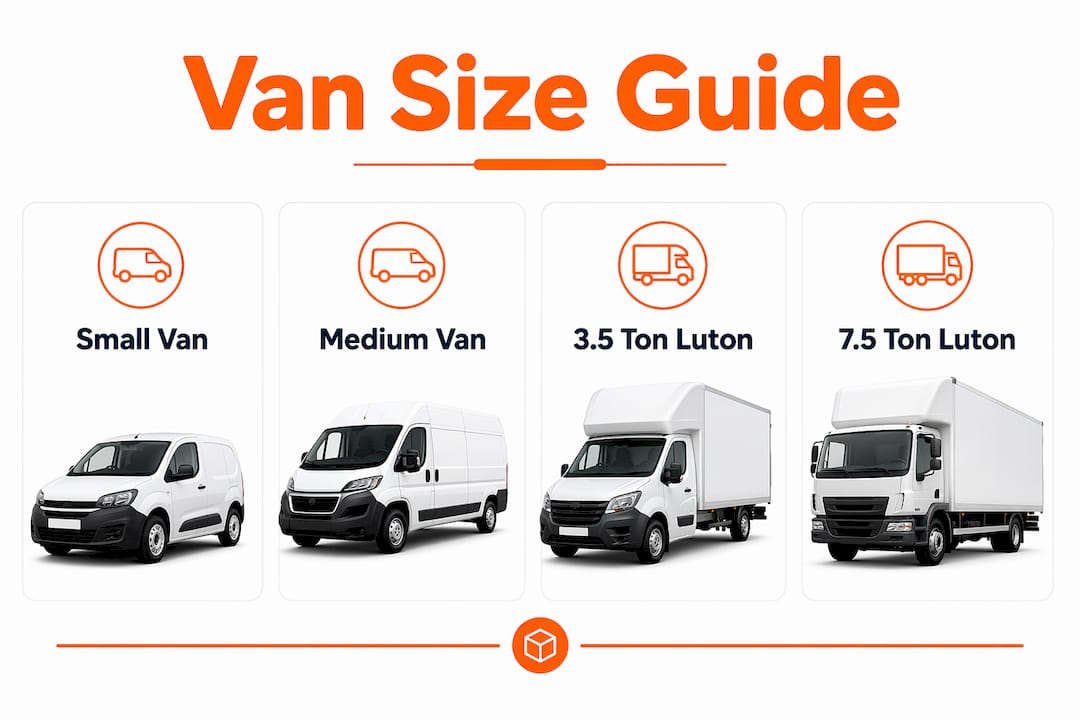
Van dimensions run from roughly 4 metres for a short wheelbase van to 6 metres for a 7.5 tonne Luton, with widths and heights varying between 1.7 and 2.3 metres. Those figures affect not just what fits inside, but where the vehicle can physically go.
A 3.5 tonne Luton van holds approximately 40–60 boxes alongside sofas, double beds, wardrobes, and white goods. That makes it the most popular choice for small houses and larger flats. Medium wheelbase vans typically hold 30–40 boxes and smaller furniture, making them well suited to 1–2 bedroom properties.
The critical mistake most movers make is underestimating volume. Homes generate between 30 and 80 boxes depending on size, and bulky furniture occupies far more space than it appears to when standing in a room. A three-seater sofa, a king-size bed frame, and a wardrobe can consume the majority of a medium van’s load area before a single box goes in.
What practical effects does van size have on packing and transport?
Van size directly controls how you pack, how long loading takes, and how many trips you need. These are not abstract concerns. They translate into hours of your day and pounds from your budget.
A van that is too small creates a cascade of problems:
- Multiple trips add fuel costs, extra hire time, and physical exhaustion.
- Overpacking to compensate risks crushing fragile items and damaging furniture.
- Poor load balance in a cramped van increases the chance of items shifting in transit.
- Time overruns can cause you to miss key handover windows, particularly on completion day.
A van that is too large carries its own penalties. It costs more to hire and more to fuel. It is harder to park on residential streets and navigate through narrow London roads. Choosing a van too small risks multiple trips and higher costs, while an oversized van increases expense and driver difficulty. Neither extreme serves you well.
The sweet spot is a van that fits your belongings in one trip with a modest amount of space to spare. That spare space is not waste. It gives you room to pack properly, protect fragile items with padding, and load furniture without forcing awkward angles that cause scratches or structural damage.

Pro Tip: Book your van size at least two weeks before your move date. Last-minute changes to van size are rarely possible and often result in paying a premium or accepting whatever is available.
Packing strategy also changes with van size. A larger van allows you to load furniture first and stack boxes around it methodically. A smaller van forces you to make difficult decisions about what goes first, often leading to inefficient loading and wasted vertical space. If you are packing a kitchen, for example, the number and weight of boxes can surprise you. Knowing your van’s load capacity before you start packing helps you plan the right number of boxes and the right packing order.
How does van size affect moving costs and budget planning?
Van size and moving cost are directly linked, but the relationship is not as simple as “bigger van equals bigger bill.” The real calculation involves hire cost, fuel, number of trips, and the risk of damage from poor packing.
- Hire cost rises with van size. A small transit costs less per day than a 3.5 tonne Luton, which costs less than a 7.5 tonne vehicle.
- Fuel consumption increases with size and weight. Larger vans use more fuel per mile, which matters on longer moves or multi-trip days.
- Multiple trips with a smaller van can easily exceed the hire cost of a larger van once you factor in fuel, time, and the risk of a second hire day.
- Tail lift vans cost more to hire but make loading heavy items like washing machines significantly safer and easier. Tail lift Luton vans are essential for heavy or bulky items, though they come at a premium rental price.
Fuel costs and hire charges are higher for larger vans, but loading everything in one trip often saves money overall. That is the calculation worth doing before you book. If you are weighing up the cost of a man and van service against a full removal company, the van size and trip count comparison is the most useful starting point.
The risk-averse approach is to book one size up from your initial estimate. The cost difference between a medium and a large van is usually modest. The cost of a second trip, or of replacing a damaged item, is rarely modest.
What legal and driving considerations affect your van size choice?
Legal restrictions and practical driving ability both narrow your van size options. Ignoring either creates real problems on moving day.
The most important legal boundary is the UK Category B driving licence. A Category B licence covers vehicles up to 3.5 tonnes maximum authorised mass. That includes most standard removal vans, including the popular 3.5 tonne Luton. A 7.5 tonne Luton van requires a Category C1 licence. If you are hiring a van and driving it yourself, this limit is non-negotiable.
Beyond the licence, physical dimensions matter enormously, particularly in London:
- Height affects access to underground car parks, low bridges, and some residential estate roads.
- Length determines whether you can park close enough to your front door to load efficiently.
- Width affects whether you can navigate narrow terraced streets without mounting the pavement.
Long wheelbase and extra-long wheelbase vans offer more load space but are noticeably harder to manoeuvre in tight urban environments. If your new or old property sits on a narrow Victorian terrace or has restricted parking, a slightly smaller van that you can actually park outside the door is worth more than a larger van parked 200 metres away.
Drivers should also consider ULEZ and Congestion Charge zones when planning routes through central London. Larger, older vans are more likely to fall outside ULEZ compliance, adding unexpected charges to your moving day costs.
Pro Tip: Before booking, check the height and length restrictions on your route, particularly if you are passing through any low bridges or entering a gated estate. A five-minute check can prevent a very expensive detour.
Key takeaways
Choosing the right van size is the most cost-effective decision you will make during your move, directly affecting packing efficiency, trip count, fuel spend, and driver safety.
| Point | Details |
|---|---|
| Match van to property size | A 3.5 tonne Luton suits most 2–4 bedroom homes; medium vans work for 1–2 bedroom flats. |
| Underestimating volume is the most common mistake | Most movers need a larger van than their first estimate; book one size up to be safe. |
| One trip usually costs less than two | Fuel, hire time, and risk of damage make multiple trips with a small van more expensive overall. |
| Licence limits your options | A UK Category B licence covers vans up to 3.5 tonnes; a 7.5 tonne van requires a Category C1 licence. |
| Driving conditions matter as much as capacity | Height, length, and width restrictions in residential areas affect which van size is practical. |
Why I always tell people to go one size bigger
Most people come to us having already decided on a van size. And most of the time, they have chosen too small. Not by a huge margin, but enough to cause problems. A sofa they forgot to measure. A wardrobe that disassembles into more pieces than expected. A collection of kitchen boxes that somehow doubled in number between packing and loading.
The instinct to save money by booking a smaller van is understandable. But the maths rarely works out. A second trip costs more than the difference in hire price between a medium and a large van. And the stress of realising mid-move that everything will not fit is genuinely unpleasant.
My honest advice is this: write down every large item in your home before you book anything. Count your rooms, not just your bedrooms. Think about the garage, the loft, the cupboard under the stairs. Then add 20 per cent to your box estimate, because you will always pack more than you think. That process takes 20 minutes and saves hours of grief on moving day.
Professional movers can also do a pre-move survey, either in person or via video call, to give you an accurate volume estimate. That service exists precisely because volume estimation is genuinely difficult without experience. Use it. The right removal service for your move depends on getting that estimate right first.
— Far
How Metrocitymoves takes the guesswork out of van size
Planning the right van size for your move does not have to be a solo exercise.

Metrocitymoves has been helping Londoners move since 2010, covering all 32 boroughs and every postcode within the M25. The team offers a full range of van sizes, from compact transit vans for studio moves to large Luton vehicles for full family house relocations. Every booking includes expert advice on which vehicle suits your volume, your route, and your budget. For house removals in London, Metrocitymoves provides fixed-price quotes so you know exactly what you are paying before moving day. If you are moving from a flat, the flat removals service includes specialist advice on van access and parking for apartment buildings. Secure removal storage is also available if your new property is not ready on the day.
FAQ
What size van do I need for a 2 bedroom flat?
A medium wheelbase van or a 3.5 tonne Luton van suits most 2 bedroom flats. Medium vans hold 30–40 boxes and smaller furniture, while a Luton handles larger items like sofas and white goods alongside your boxes.
Does van size affect how much I pay for a removal?
Yes. Larger vans cost more to hire and use more fuel, but they often save money overall by completing the move in one trip rather than two or more with a smaller vehicle.
Can I drive a Luton van on a standard UK licence?
A standard UK Category B driving licence covers Luton vans up to 3.5 tonnes maximum authorised mass. A 7.5 tonne Luton van requires a Category C1 licence, which most private individuals do not hold.
What does van capacity mean when moving house?
Van capacity refers to the total volume and weight a van can legally and physically carry. For moving purposes, this determines how many boxes and how much furniture fit in a single load, directly affecting how many trips you need.
Why do most movers choose a van that is too small?
Most movers underestimate the volume their belongings will occupy. Bulky furniture takes up more space than expected, and homes typically generate far more boxes than people anticipate when planning a move.