The best Alamy.com alternatives for UK buyers in 2026

If you need a quick shortlist, here it is. For high-volume commercial work, Shutterstock and Adobe Stock are the most practical replacements, offering broad RF libraries, subscription pricing and strong UK suitability. For editorial and exclusive campaigns, Getty Images and iStock carry the depth and RM options that Alamy is known for. On a tighter budget, Depositphotos offers clear RF licensing at predictable costs. For low-risk, in-house or blog use, Unsplash and Pexels are free and easy, though neither provides indemnity. Stocksy is worth considering when you need premium, curated imagery that stands apart from generic stock.
A few quick flags for UK buyers before you go further:
- No indemnity: Unsplash, Pexels, Pixabay and most free platforms offer no legal guarantee if a licence dispute arises. For commercial campaigns, that is a real gap.
- Editorial-only assets: Getty Images and Alamy both carry large editorial-only collections. Confirm commercial clearance on every asset before purchase.
- “Royalty-free” is not “copyright-free”: the licence still sets limits. Treat every image as a legal contract and keep records.
- Platforms that appear more expensive, like Alamy or Getty, often price that way because they sell tighter usage control and exclusivity, not simply better photos.
Key takeaways
For most UK businesses, the quickest safe move is to choose an RF subscription platform with stated indemnity for commercial work, and reserve free platforms strictly for low-risk, non-commercial use.
| Point | Details |
|---|---|
| RF vs RM | RF suits most marketing needs; choose RM only when exclusivity or tight usage control is required. |
| Indemnity matters | For paid advertising or product use, pick a platform with stated indemnity; free platforms provide none. |
| Check releases per asset | Confirm model and property release status on every image before commercial use, not just at platform level. |
| Keep a licence register | Save invoices, licence screenshots and releases for every commercial image; audit every six months. |
| Metro city moves approach | Like choosing a stock platform, choose your removal company on documented cover and transparency, not price alone. |
Table of Contents
- How do the top Alamy alternatives compare at a glance?
- What each platform is best for and how it compares to Alamy
- How do you pick the right Alamy alternative for your project?
- What do UK buyers need to know about licences, releases and indemnity?
- How we selected and compared these alternatives
- Does contributor diversity affect the images you can find?
- How do these platforms compare on customer support?
- What do UK users say about these platforms?
- What payment methods and currencies do these platforms accept for UK buyers?
- Why licence clarity is the real differentiator, not price
- Need reliable, insured professionals for your London move?
- Sources
- FAQ
How do the top Alamy alternatives compare at a glance?
| Platform | Best for | Licence types | Pricing model | Indemnity | Assets | Collection | UK suitability |
|---|---|---|---|---|---|---|---|
| Shutterstock | High-volume commercial | RF, extended | Subscription / credits | Yes (standard) | Photos, vectors, video | Very large | Strong; model/property release flags shown |
| Getty Images | Editorial & premium campaigns | RF, RM, extended | Pay-per-image / subscription | Yes (varies by tier) | Photos, video, editorial | Premium, deep editorial | Excellent; editorial flags clear |
| Adobe Stock | Creative Cloud users | RF, extended | Subscription / credits | Yes | Photos, vectors, video, templates | Large | Strong; CC plugin for in-app licensing |
| iStock | SMEs & agencies | RF, extended | Subscription / credits | Yes (stated limits; upgradeable) | Photos, vectors, video | Curated, large | Good; release status shown per asset |
| Depositphotos | Straightforward RF at scale | RF, extended | Subscription / credits | Yes | Photos, vectors, video | Large | Good; clear RF guidance |
| Dreamstime | Mixed budget & quality | RF, some RM | Subscription / credits / pay-per-image | Partial | Photos, vectors | Large, varied | Moderate; check releases per asset |
| Stocksy | Premium curated brands | RF, extended | Pay-per-image / subscription | Yes | Photos, video | Small, curated | Good; artist-approved releases |
| Envato Elements | Designers needing varied assets | RF | Subscription (unlimited downloads) | Limited | Photos, graphics, templates, video | Large, varied | Moderate; check per-asset release |
| Unsplash | Blog & low-risk in-house use | Permissive (own licence) | Free | None | Photos | Large | Limited; no indemnity |
| Pexels | Quick prototypes | Permissive | Free | None | Photos, video | Large | Limited; no indemnity |
| Pixabay | Non-commercial & small teams | Permissive | Free | None | Photos, video, illustrations | Large | Limited; variable releases |
| 123RF | Budget microstock | RF | Subscription / credits / pay-per-image | Limited | Photos, vectors, video | Large | Moderate |
Statistic to note: Industry roundups in 2026 consistently surface Shutterstock, Adobe Stock, iStock, Depositphotos, Dreamstime, Unsplash and Pexels as the most-evaluated alternatives to Alamy, reflecting where the market has settled for both paid and free stock needs.
What each platform is best for and how it compares to Alamy
Shutterstock
The most direct like-for-like replacement for Alamy’s commercial library. Shutterstock’s RF collection runs into hundreds of millions of assets, and its subscription plans make high-volume use genuinely affordable. Search filters are strong, the API is well-documented, and the Creative Cloud plugin works reliably.
- Pricing: monthly subscriptions from around £22 for 10 images; higher-tier plans for unlimited downloads
- Pros: vast collection, strong search, broad integration ecosystem, stated indemnity
- Cons: image quality is variable at the lower end; subscription auto-renewal terms need watching
- UK note: model and property release status displayed per asset; editorial flags clearly labelled
Getty Images
Where Alamy competes most directly on prestige, Getty wins on depth. Its editorial archive is unmatched for news, sport and cultural imagery, and its RM options give you genuine exclusivity. Prices reflect that. For a national advertising campaign where you cannot afford a licence dispute, Getty’s indemnity tiers are worth the premium.
- Pricing: pay-per-image for RM (can reach several thousand pounds for national campaigns); RF subscription options available
- Pros: deepest editorial archive, RM exclusivity, strong indemnity
- Cons: expensive for routine marketing use; RM admin overhead
- UK note: editorial-only flags are prominent; confirm commercial clearance before purchase
Adobe Stock
The practical choice for any team already inside the Adobe ecosystem. Licences are applied directly within Photoshop, Illustrator or InDesign, which removes the friction of downloading, importing and tracking assets separately. RF only, but the collection is large and the quality is consistently above average.
- Pricing: included in Creative Cloud All Apps plans; standalone from around £23/month for 10 assets Adobe Stock pricing details
- Pros: seamless in-app licensing, solid collection, clear RF terms
- Cons: no RM option; less useful if you are not a Creative Cloud subscriber
- UK note: release status shown per asset; strong commercial clearance documentation
iStock
A curated step down from Getty in price but not dramatically in quality. iStock’s tiered credit and subscription models suit agencies that need flexibility, and its licence guidance is among the clearest of any platform. Extended legal guarantees are available for an additional fee, which matters for higher-risk commercial uses.
- Pricing: credits from around £8 each; subscription plans available
- Pros: curated quality, clear licence documentation, upgradeable indemnity
- Cons: exclusive Getty content costs more; credit system can be confusing
- UK note: commercial vs editorial labelling is explicit per asset
Depositphotos
Straightforward RF licensing with clear guidance on what the licence permits and predictable subscription pricing. A solid workhorse for marketing teams that need volume without complexity. Not the place for RM or exclusive content, but for most everyday commercial needs it covers the ground well.
- Pricing: subscription plans from around £9/month; credit packs available
- Pros: clear RF terms, competitive pricing, large library
- Cons: no RM; collection depth thinner than Shutterstock at the specialist end
- UK note: good release documentation; check editorial flags on news-style images
Dreamstime
A mixed library with both RF and some RM options, and pricing that ranges from free downloads to pay-per-image. The contributor base is wide, which means quality varies. Worth checking for niche subjects where larger platforms are thin, but do verify release status carefully.
- Pricing: free tier available; credits and subscriptions for paid assets
- Pros: pricing flexibility, wide contributor base, some RM options
- Cons: inconsistent quality; release documentation less standardised
- UK note: check each asset’s release status; editorial flags present but variable
Unsplash, Pexels and Pixabay
These three free platforms are genuinely useful for blog imagery, internal presentations and low-stakes creative work. The quality on Unsplash in particular is high. The hard limit is indemnity: none of them provide legal protection if a release or copyright dispute arises. For any campaign that will appear in paid advertising or on product packaging, use a paid platform instead.
Pro Tip: Keep free-platform images strictly for internal or editorial use. The moment an image appears in a paid ad, on a product, or in a client-facing campaign, switch to a paid platform with stated indemnity.
Stocksy
A co-operative model where photographers retain more control, which shows in the quality. Stocksy’s collection is small by industry standards but deliberately curated, and the imagery tends to look less generic than Shutterstock or iStock. RF and extended licences are available. Price per image is higher than microstock, but for brands that need imagery that does not look like everyone else’s, it is a reasonable premium.
Envato Elements
One subscription covers photos, graphics, templates, fonts and video. For designers and agencies that consume a wide variety of digital assets, the economics are strong. Release documentation is less standardised than dedicated photo platforms, so check each asset before commercial use.
123RF
A large microstock provider with subscription, credit and pay-per-image options. Pricing is competitive and the library is broad. Indemnity is limited compared to Shutterstock or Getty, so it suits lower-risk commercial uses rather than high-profile campaigns.
Smaller and specialist platforms
Several other platforms appear in aggregator lists and are worth a brief mention. Storyblocks offers an unlimited subscription model focused on video, audio and photos, which suits video production teams. Magnific (formerly Freepik) provides a large library of vectors, illustrations and photos under a freemium model, with premium plans removing attribution requirements. Flaticon specialises in icons and vector graphics rather than photography. Yay Images is a smaller RF subscription service with competitive pricing. KaboomPics and Barnimages are free lifestyle-focused libraries with permissive licences, suitable for blog and social use. NegativeSpace, picjumbo, Morguefile, SnapSpaces, Good Stock Photos, PhotoFinder, Photoshift, Ingimage, PatternedAI and Crestock are additional sources that appear in discovery lists; for any of these, verify licence terms and release documentation directly on the platform before commercial use, as public information on indemnity and release standards is limited.
How do you pick the right Alamy alternative for your project?
Start with your licence need, not your budget. The two questions that narrow the field fastest are: do you need exclusivity, and does the image carry legal risk if a release is missing?
- Decide on RF or RM. For most marketing, website and social media use, RF is sufficient and far cheaper to manage. RM is the right choice only when you need to prevent competitors from using the same image, or when a campaign requires tightly controlled territory and duration terms. RF offers simpler one-time fees; RM pricing varies by territory, duration, media and exclusivity.
- Assess your volume. A single campaign image is best bought pay-per-image or on credits. Ongoing content production, where you need 20 or more images a month, almost always makes a subscription cheaper.
- Set your indemnity requirement. If the image will appear in paid advertising, on product packaging or in a high-profile campaign, choose a platform with stated indemnity. Some platforms publish indemnity caps and offer extended guarantees for an additional fee; check the exact figure before purchase.
- Check integration needs. If your team works in Adobe apps, Adobe Stock’s in-app licensing removes a step. If you need API access for automated workflows, Shutterstock and Getty both publish documented APIs.
- Confirm asset type. Not every platform covers vectors, video or illustrations equally. Envato Elements and Adobe Stock are stronger for mixed asset types; Flaticon and Magnific lead on icons and vectors.
- Verify UK suitability. Confirm that model and property releases are documented for each asset you intend to use commercially. Official asset pages show release status and commercial clearance; do not assume.
Red flags to walk away from: vague licence language that does not specify territory or duration; no stated indemnity for commercial use; missing model release on images of identifiable people; no clear distinction between editorial and commercial assets.
What do UK buyers need to know about licences, releases and indemnity?
Royalty-free and rights-managed are the two main licence models in stock photography, and the distinction matters more than most buyers realise.
RF (Royalty-Free): you pay once and can reuse the image across multiple projects within the licence terms. The licence still sets limits, typically on print run, geographic territory and whether the use is editorial or commercial. “Royalty-free” does not mean “copyright-free” and it does not mean unrestricted. The copyright remains with the photographer.
RM (Rights-Managed): pricing is calculated per use, based on territory, duration, media type and exclusivity. RM licences can reach several thousand pounds for a national advertising campaign, but they give you control that RF cannot. If a competitor using the same RF image is a genuine business risk, RM is the answer.
Extended licences sit above standard RF and cover uses like resale on physical products, unlimited print runs or broader digital distribution. Most platforms offer them as an add-on.
UK legal notes for commercial buyers:
- A signed model release is required for any image of an identifiable person used in advertising or commercial promotion. Always confirm a model release exists and retain that documentation.
- Property releases are needed for recognisable private buildings or interiors used commercially.
- Editorial-only images cannot legally be used in advertising, regardless of what you paid for them.
- For unique or high-risk uses, commissioning a photographer with a written IP assignment is the safest route; stock is the pragmatic alternative when bespoke production is not practical.
Pro Tip: Keep a licence register: save the invoice, a screenshot of the licence page, and any model or property release for every image you use commercially. Audit it every six months. This one habit removes most of the legal risk that businesses face with stock imagery.
How we selected and compared these alternatives
The shortlist was built by comparing platforms on six criteria: licence clarity, indemnity provision, pricing transparency, editorial labelling, search and integration capability, and UK suitability (model and property release coverage).
- Licence clarity: we checked each platform’s public licence page for plain-language definitions of permitted uses, territory limits, and the distinction between editorial and commercial assets.
- Indemnity: we noted whether platforms publish stated indemnity amounts and whether extended guarantees are available for purchase.
- Pricing transparency: we assessed whether pricing is publicly listed, whether subscription terms are clear, and whether credit expiry or auto-renewal terms are disclosed upfront.
- Editorial labelling: we checked whether editorial-only assets are clearly flagged at the asset level, not just in the terms of service.
- Search and integrations: we reviewed API availability, Creative Cloud plugin support, and filter quality for licence type, orientation and release status.
- Contributor diversity: we noted the breadth of contributor bases and geographic coverage where publicly stated.
Data sources used: official platform licence pages, platform help centres, industry analysis from G2, Photutorial’s 2026 roundup, 99designs’ licence vocabulary guide, Sprintlaw UK’s legal guidance, and Appvizer’s alternatives list. This review is based on publicly available documentation only; enterprise-level contracts with non-disclosed pricing are not assessed.
Does contributor diversity affect the images you can find?
Geographic and cultural diversity in a stock library’s contributor base directly affects whether you can find images that reflect your audience. Shutterstock and Getty Images have the broadest global contributor networks, which translates into stronger coverage of non-Western locations, diverse ethnicities and regional contexts. Adobe Stock benefits from its integration with Behance, which draws contributors from a wide creative community worldwide.
Smaller platforms like Stocksy and Unsplash tend to skew towards Western European and North American aesthetics, which can be a limitation for UK brands targeting diverse urban audiences. Dreamstime’s wide contributor base produces more geographic variety than its size might suggest, though quality is less consistent. For UK-specific imagery, including recognisable London locations or British cultural contexts, Getty and Shutterstock both have dedicated editorial collections that smaller platforms cannot match.
How do these platforms compare on customer support?
Support quality varies considerably across the platforms covered here. Getty Images and Adobe Stock offer dedicated account management for business and enterprise customers, which matters when a licence dispute or urgent asset need arises. Shutterstock provides live chat and email support across its plans, with response times that are generally reliable for standard queries.
iStock’s support is routed through Getty’s infrastructure, which means business account holders get reasonable access but individual credit buyers may find response times slower. Depositphotos offers email and live chat support and is generally responsive for billing and licence queries. Free platforms, Unsplash, Pexels and Pixabay, provide minimal support by design; community forums and help articles are the primary resource. For any platform where you are spending significant budget, test the support channel with a pre-purchase query before committing to a subscription.
What do UK users say about these platforms?
In the UK market, Shutterstock and Adobe Stock consistently receive positive feedback from marketing teams for search quality and licence clarity. iStock is frequently cited by agencies for its curated collection and the transparency of its licence documentation. Depositphotos draws positive reviews for pricing predictability, particularly from small businesses managing tight content budgets.
Getty Images receives strong professional endorsement for editorial and premium commercial work, though cost is a recurring concern for smaller buyers. Stocksy has a loyal following among brand managers and creative directors who prioritise image distinctiveness. Free platforms like Unsplash attract high satisfaction scores for ease of use, with the caveat that experienced buyers note the absence of indemnity as a practical limitation for commercial work. Platforms with less public UK presence, including several of the smaller entrants listed above, have limited verifiable review data in the UK market; treat aggregator listings as a starting point and verify terms directly.
What payment methods and currencies do these platforms accept for UK buyers?
Most major platforms accept UK debit and credit cards (Visa, Mastercard), and several accept PayPal. Shutterstock, Adobe Stock, Getty Images and iStock all price in GBP for UK buyers, which removes currency conversion costs and makes budgeting straightforward. Depositphotos and 123RF typically price in USD but accept UK cards, so check your card’s foreign transaction fee before subscribing.
Adobe Stock billing integrates with existing Creative Cloud accounts, meaning UK teams on annual plans can manage stock costs within a single invoice. Envato Elements similarly bills in USD but accepts UK cards and PayPal. For enterprise buyers, Getty and Shutterstock both offer invoiced billing on account, which simplifies purchase order processes for larger organisations. Free platforms require no payment method at all, though Unsplash’s API access for commercial integrations may require account registration.
Why licence clarity is the real differentiator, not price
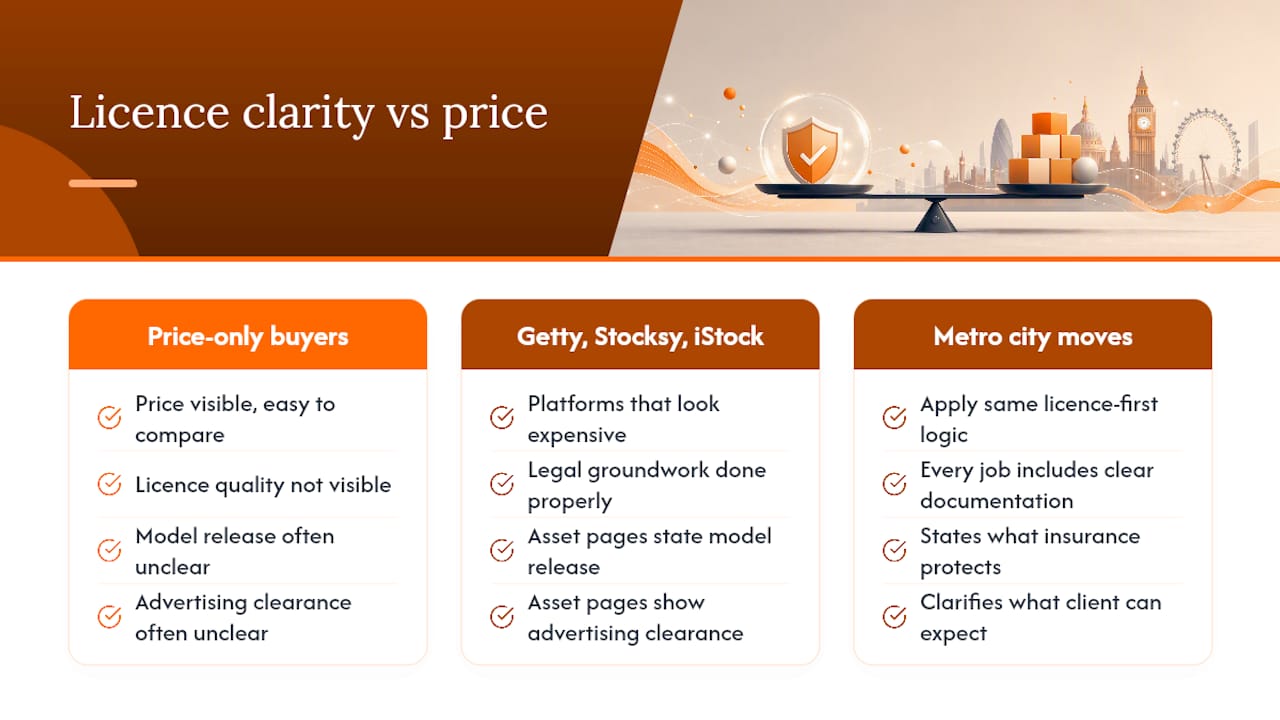
Licence clarity and indemnity are the single biggest differentiators for any business buying stock imagery commercially. Price is visible and easy to compare; the quality of a licence is not, and that is where most buyers get caught out.
The platforms that look expensive, Getty, Stocksy, iStock with extended guarantees, are often the ones that have done the legal groundwork properly. Their asset pages tell you clearly whether a model release exists, whether the image is cleared for advertising, and what indemnity you have if something goes wrong. That transparency has a real value that does not show up in a per-image price comparison.
At Metro city moves, we apply the same logic to our own services. Every job comes with clear documentation of what is covered, what the insurance protects, and what the client can expect. The businesses that have the worst experiences with any service provider, removals or stock photography, are usually the ones who chose on price alone and only read the small print after something went wrong. Budget for the licence that actually protects you. The saving on a cheaper platform is rarely worth the exposure.
Need reliable, insured professionals for your London move?
There are plenty of stock photo platforms to choose from, and the right one depends on your licence needs and risk appetite. When it comes to moving home or office in London, the same principle applies: the provider you choose should be transparent about what they cover, fully insured, and experienced enough to handle the unexpected.
Metro city moves has been handling house removals across London since 2010, covering all 32 boroughs and every postcode within the M25. Every job is fully insured, priced upfront with no hidden charges, and carried out by an experienced team. Whether you need a full house move, office relocation, packing, storage or same-day delivery, you get a fixed quote before anything moves. Get in touch for a free, no-obligation quote and find out why thousands of London residents and businesses have trusted Metro city moves with their move.
Sources
- A Beginner’s Guide to Royalty-Free Licensing | Depositphotos
- Defining licensing models - Stock Photography News, Analysis and Opinion
- Using images legally on your UK business website | Sprintlaw UK
- The 8 best stock photo sites in 2026 | Photutorial
- Top 10 Alamy Alternatives & Competitors in 2026 | G2
- Stock image licences vocabulary | 99designs
- Stock photos and image licensing best practices | iStock
FAQ
What is similar to Alamy for UK buyers?
Shutterstock, Getty Images, Adobe Stock and iStock are the closest like-for-like alternatives, covering both RF and RM options with stated indemnity and strong UK suitability. Depositphotos is a strong choice for straightforward RF licensing at lower cost.
What is the best free stock photo site?
Unsplash is widely regarded as the strongest free option for image quality, followed by Pexels and Pixabay. All three lack indemnity, so they are only suitable when legal risk is low and model/property releases are not required. For any image used in paid advertising, commercial promotion or on products, select a paid platform with stated indemnity and release documentation.
Which is better, Alamy or Shutterstock?
Shutterstock is better for high-volume RF commercial use, with subscription pricing that makes ongoing content production affordable. Alamy’s strength is its RM and editorial depth, particularly for exclusive or archival content where tighter usage control justifies the higher per-image cost.
Why is Alamy so expensive?
Alamy prices reflect its RM and premium editorial focus. Platforms that offer RM or exclusive content appear more expensive because they sell tighter usage control and less common assets, not simply better photography. If you only need standard RF images for marketing, an RF-focused platform will cost considerably less.