How long distance removals work: a complete guide
A long distance removal is defined as the professional relocation of household goods over distances generally exceeding 100 miles, requiring specialist vehicles, multi-day scheduling, and detailed logistical planning. This is a distinct service from a local move. Understanding how long distance removals work helps you avoid the most common and costly mistakes: underestimating volume, missing access issues, and booking too late. This guide covers the full process from scheduling and cost structure to service types and preparation, so you arrive at your new home with your belongings intact and your stress levels manageable.
How are long distance removals scheduled and executed?
Long distance removals follow a structured sequence: loading at the origin, transport to the destination, and unloading on arrival. For shorter routes under 400 miles, a single day is often achievable. Moves exceeding 400 miles are treated as two-day operations, with the crew loading on day one, completing an overnight stop, and unloading on day two.

Driver hours regulations are a hard constraint on scheduling. Legal driver hour limits of 9 hours per day, combined with mandatory rest periods, mean professional removal firms must plan routes carefully to stay compliant. Delays at either end of the move can cascade into overnight accommodation costs and rescheduled delivery windows.
Timing coordination is critical. Your removal team needs to align with your property completion date, key handover, and access windows at both addresses. If you are moving from a flat with a service lift, the building management may restrict access to certain hours. Communicate these constraints to your removal company before the booking is confirmed.
- Survey and quote: A virtual or physical pre-move survey assesses volume and access at both properties.
- Booking confirmation: Dates, vehicle type, and crew size are locked in.
- Packing day (optional): Professional packers attend the day before the move.
- Loading day: The crew arrives at your origin address and loads the vehicle systematically.
- Transit: The vehicle travels to the destination, with overnight staging for longer routes.
- Unloading day: Goods are delivered and placed in the correct rooms.
Pro Tip: Book your access windows at both properties in writing before moving day. Verbal agreements with building managers or estate agents are frequently forgotten under the pressure of completion.
What factors influence the cost of long distance removals?
Distance sets the cost baseline, but it is rarely the deciding factor in your final bill. The baseline cost estimate for long distance transport sits at approximately £1.25 per mile, but volume and access complexity act as the true multipliers on what you actually pay.
Two households moving the same route can receive quotes that differ by hundreds of pounds. Volume and access complexity drive that variance. A three-bedroom house with a narrow lane, no parking, and a spiral staircase costs significantly more to move than a two-bedroom flat with a car park and a ground-floor entrance.
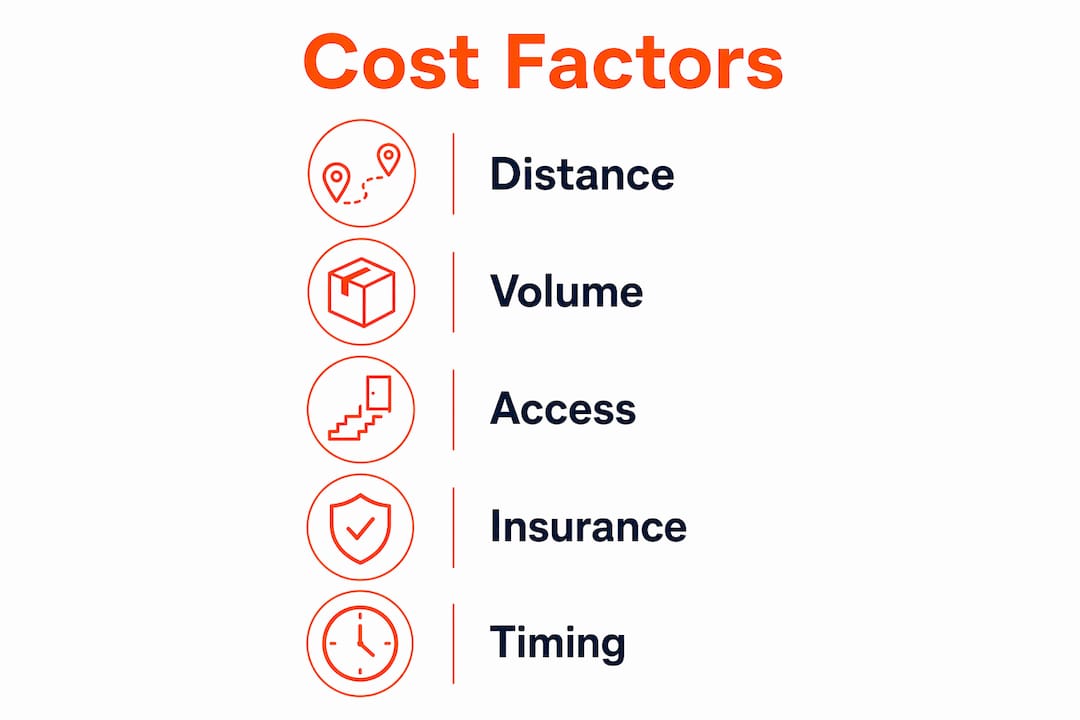
The main cost factors beyond mileage are:
- Volume in cubic metres: The more space your goods occupy in the vehicle, the higher the cost.
- Access at origin and destination: Narrow roads, restricted parking, and multiple flights of stairs all add time and labour.
- Additional services: Professional packing, furniture dismantling, and secure storage each carry separate charges.
- Timing: Peak season moves between may and september command premium rates.
- Vehicle type: Specialist long-haul vehicles cost more than standard local vans.
| Cost factor | Impact on price |
|---|---|
| Distance (per mile) | Sets the baseline; £1.25 per mile is a common starting estimate |
| Volume (cubic metres) | Primary multiplier; larger loads require bigger vehicles or multiple trips |
| Access difficulty | Narrow lanes, stairs, and parking restrictions add labour time and cost |
| Additional services | Packing, dismantling, and storage add directly to the total |
| Timing flexibility | Flexible dates allow backloading discounts on cross-country routes |
Pro Tip: Accepting flexible delivery dates allows removal firms to combine your load with a return trip, which can reduce your cost meaningfully on longer routes.
How do long distance removals differ from local moves?
A local move is typically completed within a single working day using a standard van and a two-person crew. A long distance removal is a different operation entirely. Long distance removals are logistical projects requiring verified inventories, access checks at both ends, and travel timing coordination to prevent day-of failures.
The operational differences are significant:
- Multi-day scheduling: Longer routes require overnight stops, crew accommodation, and vehicle security planning.
- Regulatory compliance: Driver hours rules impose hard limits on daily travel, affecting when your goods arrive.
- Specialist vehicles: Long-haul vehicles are selected for route suitability, fuel efficiency, and cargo security, not just load size.
- Packing standards: Longer transit times expose your goods to greater vibration and handling risk, making double-walled cartons and professional packing far more important than on a short move.
- Contingency planning: A local move delayed by an hour is an inconvenience. A long distance move delayed by a day means accommodation costs and rescheduled access windows.
Long distance removals are not simply extended local moves. They are full logistical operations that require the same level of planning as a commercial project, with clear milestones, verified information, and contingency plans built in from the start.
Administrative tasks also multiply on longer moves. Utility transfers, address changes with HMRC, the DVLA, and your bank, and redirecting post all take longer to arrange when you are relocating to a different region. These tasks are easy to overlook when you are focused on the physical move.
What practical steps help you prepare for a long distance removal?
Preparation is the single biggest factor separating a smooth long distance relocation from a stressful one. Book your removal company at least 6–12 weeks before your move date. During peak season between may and september, 8–12 weeks is the minimum. Good removal firms fill their diaries quickly, and last-minute availability on long distance routes is genuinely scarce.
Follow these steps to plan effectively:
- Create a detailed inventory: List every item by room, noting dimensions for large pieces and flagging anything fragile or high value.
- Conduct an access check at both addresses: Measure doorways, note parking restrictions, and identify any floors served only by stairs. Access challenges at both ends are a leading cause of delays and added costs on moving day.
- Request a survey: Virtual surveys via video call are now standard practice and allow removal firms to provide fixed-price quotes without an on-site visit.
- Decide on packing: Professional packing is worth the cost for fragile items, antiques, and anything irreplaceable. Self-packing is fine for books, clothes, and robust household goods.
- Plan for the gap: If your new property is not ready on the same day your old one completes, you need a storage solution and temporary accommodation. Build this into your budget from the start.
- Pack an essentials box: Keep a separate bag or box with documents, phone chargers, a change of clothes, and basic kitchen items. This travels with you, not in the removal vehicle.
Pro Tip: For a London to Manchester move, check the typical cost breakdown before requesting quotes. Knowing the market rate prevents you from overpaying or dismissing a fair price as too high.
What types of long distance removal services are available?
Two main service types cover the majority of long distance UK removals: dedicated vehicle moves and part-load services (also called groupage or backloading). Choosing between them depends on your volume, your budget, and how firm your delivery date needs to be.
| Service type | How it works | Best suited for |
|---|---|---|
| Dedicated vehicle | Your goods fill the entire vehicle; delivery date is fixed and agreed in advance | Larger households, time-sensitive moves, or high-value items |
| Part-load (groupage/backload) | Your goods share vehicle space with another customer’s load; delivery window is broader | Smaller volumes, flexible timelines, and budget-conscious moves |
A dedicated vehicle gives you a confirmed delivery window and direct control over the schedule. You pay for the full vehicle regardless of how much space your goods occupy. This is the right choice for a three or four-bedroom house move, or any situation where arriving on a specific date is non-negotiable.
A part-load service reduces cost by sharing the vehicle with one or more other customers. The trade-off is a broader delivery window, sometimes several days rather than a specific date. This suits smaller moves, students relocating, or anyone with flexible timing. Metrocitymoves offers long distance removals across the UK with both service structures, tailored to the volume and timing requirements of each customer.
Key takeaways
Long distance removals are multi-day logistical operations governed by driver hours regulations, volume-based pricing, and access complexity at both ends of the route.
| Point | Details |
|---|---|
| Book early | Secure your removal firm 6–12 weeks ahead; 8–12 weeks during peak season. |
| Cost drivers | Volume and access complexity matter more than mileage alone in determining your final price. |
| Two-day operations | Moves over 400 miles require overnight staging due to legal driver hour limits. |
| Service choice | Dedicated vehicles offer fixed delivery dates; part-load services reduce cost with flexible timing. |
| Preparation | A detailed inventory and access check at both properties prevents the most common day-of problems. |
What I have learned from watching long distance moves go wrong
After years of working in removals, the pattern I see most often is not a logistics failure. It is a planning failure that happens weeks before moving day.
Customers consistently underestimate two things: the volume of their goods and the complexity of access at their new address. A three-bedroom house in London rarely fits in the same vehicle as a three-bedroom house in Manchester, because London properties accumulate more storage in smaller spaces. Loft contents, under-stair cupboards, and built-in wardrobes add cubic metres that never appear in a rough estimate.
The second problem is access. A narrow lane, a low bridge on the approach road, or a residents-only parking zone can stop a large removal vehicle before it reaches your front door. These are not rare edge cases. They are common enough that professional firms now conduct detailed access checks as standard, and you should insist on one even if the firm does not raise it first.
The customers who have the smoothest long distance moves treat the process as a project with defined stages. They confirm their inventory early, they communicate access details clearly, and they build a contingency day into their timeline. The customers who struggle are the ones who assume the removal firm will handle everything without being given the information to do so.
My honest advice: do not wait until you have a completion date to start planning. Begin the inventory, the access checks, and the supplier conversations the moment you know you are moving. The earlier you start, the more options you have.
— Far
How Metrocitymoves handles long distance removals
Metrocitymoves has been operating professional house removals across London and the UK since 2010. The team handles long distance moves as full logistical operations, not extended local jobs.
Every long distance booking includes a pre-move survey, fixed-price quoting, fully insured Goods in Transit cover, and a dedicated crew experienced in multi-day moves. Packing services, furniture dismantling, and secure storage are available as part of a complete package. Whether you are moving from a London flat to Edinburgh or from a family home in Surrey to the north of England, Metrocitymoves coordinates every stage from loading to delivery. Request a free quote and get a clear, fixed price with no hidden charges.
FAQ
What counts as a long distance removal in the UK?
A long distance removal generally covers moves exceeding 100 miles. Moves over 400 miles are typically scheduled as two-day operations due to driver hours regulations.
How far in advance should I book a long distance removal?
Book at least 6–12 weeks before your move date. During peak season between may and september, 8–12 weeks is the recommended minimum to secure availability.
How is the cost of a long distance removal calculated?
Distance sets the baseline at approximately £1.25 per mile, but volume in cubic metres and access complexity at both properties are the primary drivers of the final price.
What is the difference between a dedicated vehicle and a part-load service?
A dedicated vehicle reserves the entire lorry for your goods with a fixed delivery date. A part-load service shares space with another customer’s load and offers a broader, more flexible delivery window at a lower cost.
Do I need specialist insurance for a long distance removal?
Standard Goods in Transit cover from a professional removal firm protects your belongings during transport. For high-value or irreplaceable items, check the policy limits and consider additional moving insurance before moving day.