
Office removals · Central London
Office removals in Central London, where there is nowhere to put anything down
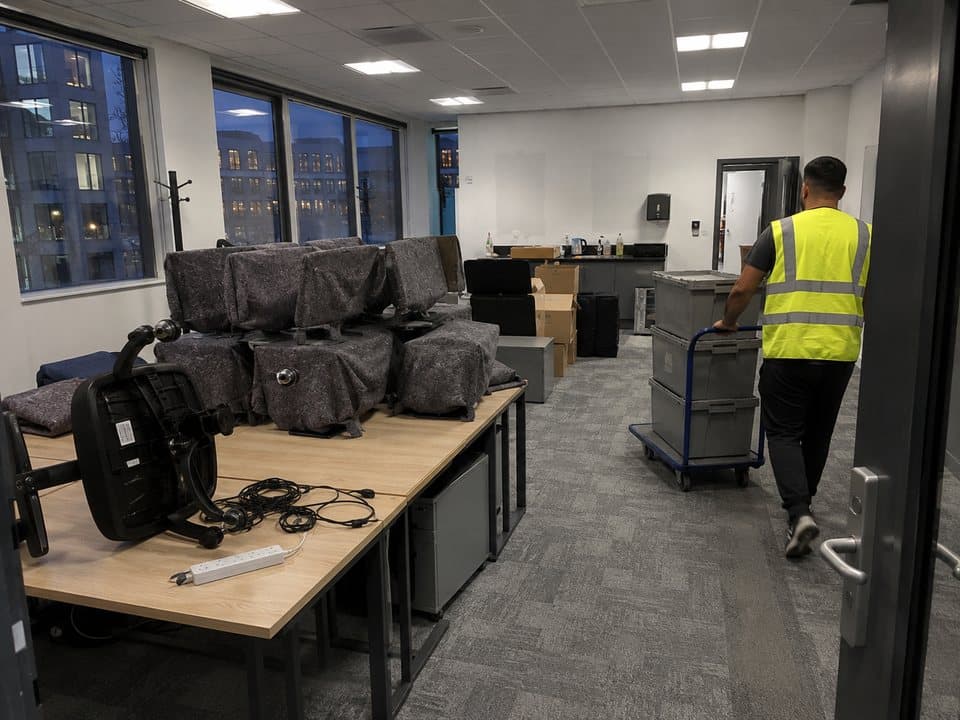
Office removals in Central London are organised around a single fact: there is nowhere to put anything down. The corridor outside your suite is a means of escape, so the building requires it kept clear. The common parts belong to the building, and nothing may be left in them, even briefly. The pavement is public highway, and the lift lobby is shared with every other tenant in the building. So the ordinary method, which is to empty the rooms into a holding area and then load steadily, is unavailable here. The sequence inverts instead: everything is crated and labelled against a numbered plan before the day.
 Written by Daniel, founder, Metro City Moves
The constraint
No holding area, at either end
So the plan is
Crated, labelled, loaded in order
Quote
In writing, after a survey
What is different here
Office removals in Central London is its own job
What changes the plan and the price here, rather than a list that would fit any London postcode.
Your demise ends at the suite door, and nothing waits past it
Past that door the corridor is a means of escape, and the building requires it kept clear at every moment of the move. Crates therefore cannot line up outside while they wait to go down. The shared lobby belongs to the building, and the staircase is nobody's storeroom. The building management will also expect a named contact, an agreed window, and the common parts protected before the first crate moves and signed off after the last one. We arrange that protection at both addresses, because both addresses are somebody else's building.
The pavement is public highway, so the vehicle becomes the staging area
Outside the door on Chancery Lane, or on the footways around Covent Garden, the pavement is in use all day and it is public highway rather than a yard. A stack of crates cannot be assembled on it, and a vehicle cannot simply stand and wait beside it either. That inverts the ordinary method completely. Instead of emptying the rooms into a holding area and loading at leisure, we load in sequence. Whatever leaves the floor goes straight onto the vehicle, and whatever comes off the vehicle goes straight to its marked position. The loaded van carries the running order, because nothing else can.
The packing has to be finished before the move begins
Where a building has spare floor space, packing can continue alongside the loading. Here it cannot, because a half-packed room has nowhere to go while it waits. Everything is crated, lidded and labelled against the numbered plan before the first trolley leaves the suite. That is why the crate count agreed at the survey matters more in Bloomsbury or on Fleet Street than almost anywhere else we work. A crate nobody counted has no corner to stand in. We count the desks, the pedestals, the archive and the kitchen at the survey. The empty crates arrive in time for the packing rather than on the morning itself.
Where two buildings refuse the same window, the move runs as part-loads
The building you are leaving and the building you are entering are managed by different people under different arrangements, and their windows frequently do not meet. The move then cannot run out and back in on one continuous journey. The honest answer is a part-load, or a holding load that remains with us between the two halves. That is considerably better than a crew waiting at a locked entrance, or crates standing in a shared corridor overnight. We confirm which portion runs when, in writing, before you fix a date. What we will not do is plan one unbroken day and hope both buildings agree to it.
Where this applies
The parts of Central London this page is about
Named, because a page about an area in general is no use to anyone standing in one. These are the places where what is written above is what we actually find.
- Covent Garden
- Farringdon
- Holborn
- Bloomsbury
- Chancery Lane
- Fleet Street
- Before you fix a date
- Ask the building management what it requires in the common parts: protection, a named contact on site, and whoever signs the route off afterwards.
- Walk the route from your suite door to wherever a vehicle can stand. Tell us what is along it: thresholds, a ramp, a second set of doors.
- Agree the crate count at the survey and order against it, because there is nowhere to stack whatever nobody counted.
- Number the desk positions at the destination before the packing begins, so that every crate has somewhere particular to land.
- Establish the window each building permits. Where the two do not meet, say so early and we plan it as part-loads.
Questions
Office removals in Central London, answered
- We have no spare room to stack the boxes. How does that work?
- That is the ordinary situation here and the plan assumes it. Nothing is stacked in the corridor, in the shared lobby or on the footway, so the vehicle does the holding instead. The floor is emptied in the order the van is loaded, and the van is unloaded in the order the numbered plan requires.
- Can your crew pack us on the morning of the move?
- Not in Central London, and the reason is space rather than labour. A half-packed room needs somewhere to stand and there is nowhere available. We pack and crate on an earlier visit, label everything against the numbered plan, and then move a floor that is already finished.
- Our two buildings will not allow the same window. Is it still one job?
- It is one job in two portions. The load comes out inside the window the first building permits, and it remains with us until the second building opens. You get the sequence in writing, including whatever travels on each portion, so nothing is left standing in a shared corridor while you wait.
- What decides the price of an office move in Holborn or Farringdon?
- The carry from your suite door to wherever the vehicle can stand, the crate count, and whether the two buildings allow you one window or two. The kerb itself is a separate subject, covered on removals in Central London. We survey before we quote, the quote comes in writing, and the number you accept is the number you pay.
Keep reading
Everything else on office removals and on Central London
Office removals elsewhere in London
Related reading
Before you book in Central London
Parking suspensions, red routes and the ULEZ — read from the councils' and TfL's own pages, with the date each fact set was checked.
- Guide
London parking suspensions for moving house: what every borough charges
The same one-day parking suspension costs £66.66 in Camden and £360 in Haringey. Fees, notice periods and removals concessions for nine boroughs, compared.
Read it - Guide
Parking suspension vs dispensation: which one a house move needs
A suspension reserves the parking bay; a dispensation only stops the ticket. That difference decides what a house move needs, and what each borough charges.
Read it - Guide
Red route dispensations: moving house where the council cannot help
TfL sells no parking suspensions on red routes at any price. A dispensation costs £48 a day, needs 6 working days, and red lines take no late applications.
Read it - Guide
ULEZ, removals vans and the Congestion Charge on moving day
ULEZ charges a non-compliant removals van £12.50 a day, everywhere in London, and the Congestion Charge is £18 in the centre. What applies on moving day.
Read it
What people say
Reviews left by people we have moved
Left on our Google profile. Every card links back to it, so you can read the rest — including any we would rather you did not.
Good experience with Metro City Moves. 4 bedroom house seemed bit difficult to move from London to Liverpool, but they planned well and successfully executed. Thank you.
Saqib AwanRead on Google, opens in a new tab
Get started
Tell us where you are moving from
Send a postcode and we will come back to arrange the survey, which we can do on a video call.
What you get before you commit
- A survey first, by video call or in person, so the price is built on what is actually there.
- The quote in writing, listing what is included and what is not, so both sides read the same list.
- Anything you add before you accept is priced into the quote you sign off.
Talk to us about your move
Every London postcode, 16 services, and answered at any hour — including nights and weekends.